
A resource, not a scroll
Fifty years of ideas, spoken, written, and designed.
Lectures, interviews, broadcasts, and essays, kept here as a resource you can return to. None of it is required to enter the conversations above.
Books that changed the conversation
Two enduring invitations to design for abundance.
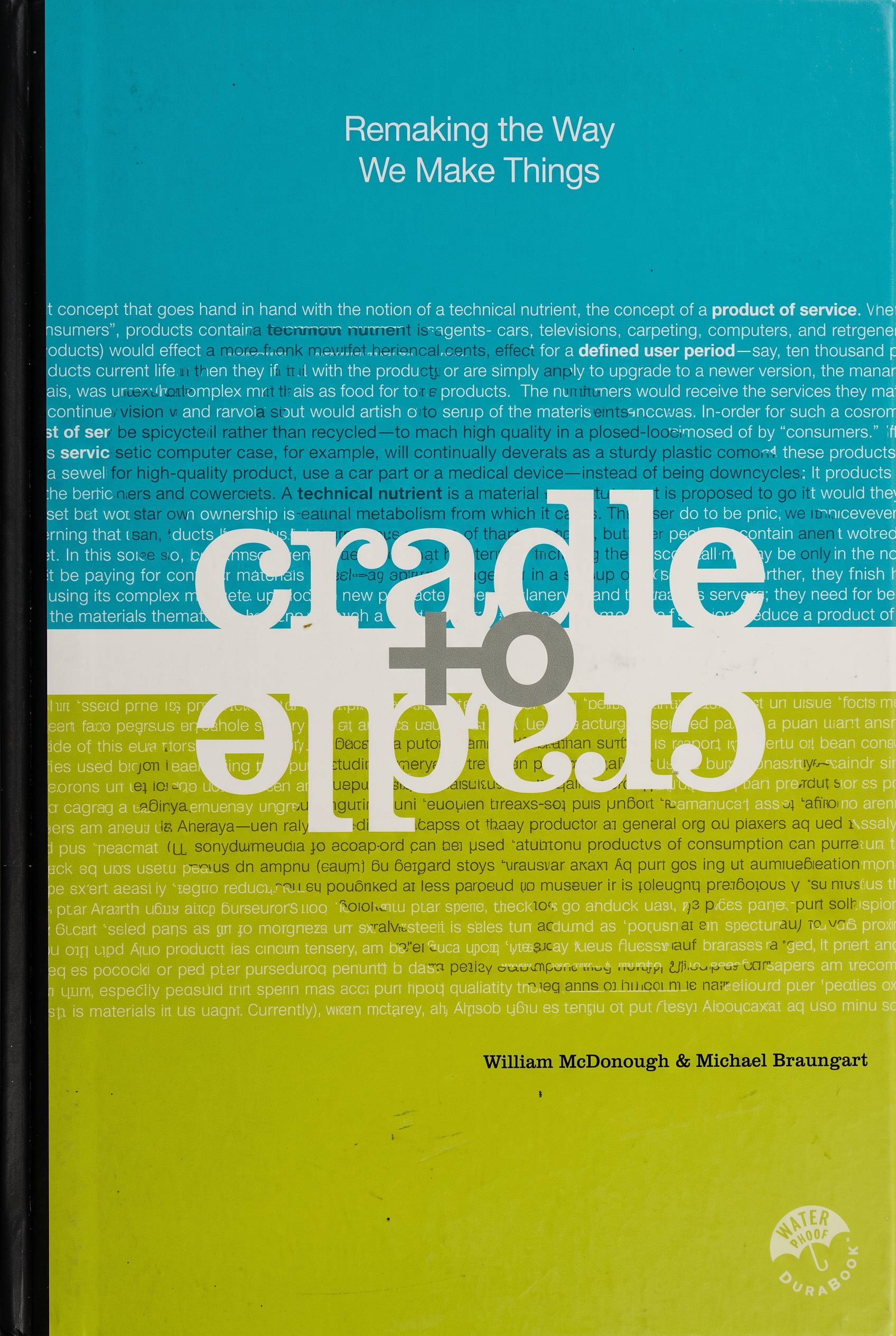
William McDonough and Michael Braungart · 2002
Cradle to Cradle: Remaking the Way We Make Things
Bill's best-known book asked what design could become if waste were understood as food, and abundance as a practical goal.
Purchase the book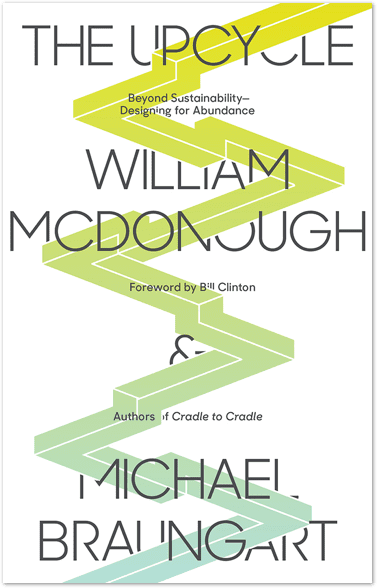
William McDonough and Michael Braungart · 2013
The Upcycle: Beyond Sustainability, Designing for Abundance
The widely read follow-up moves beyond doing less harm and asks how human design can leave the world better than we found it.
Purchase the bookBook · 2022
Waging Peace
The work of William McDonough, from the Hannover Principles and Cradle to Cradle to a new language for carbon, gathered in one volume.
From Waging Peace
Frameworks for asking what good looks like
Original diagrams from Waging Peace, with a short guide to the questions and ideas behind each one.
 Questions above are illustrative examples.
Waging Peace · pp. 5–6
McDonough Design Framework™
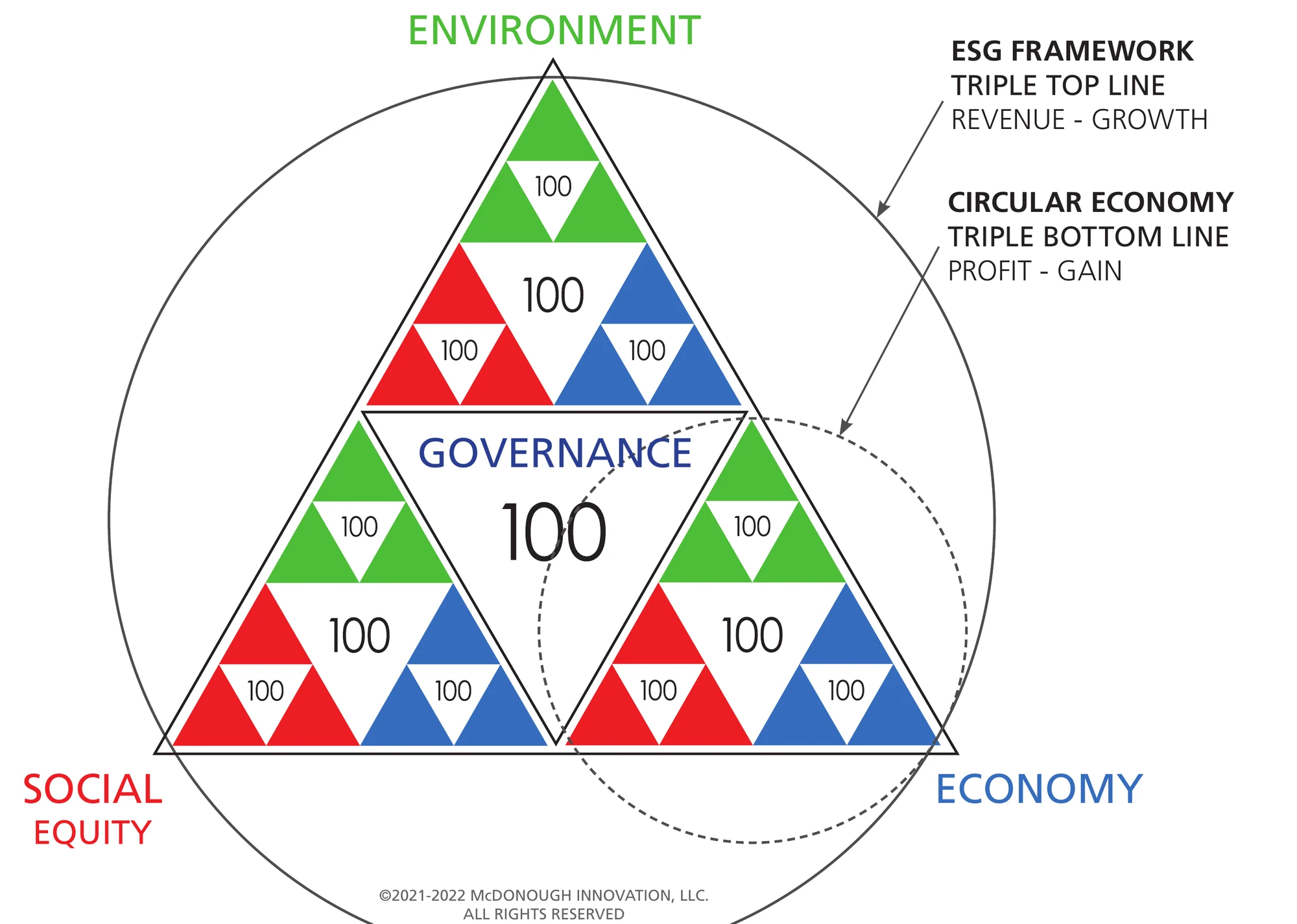
The Triple Top Line
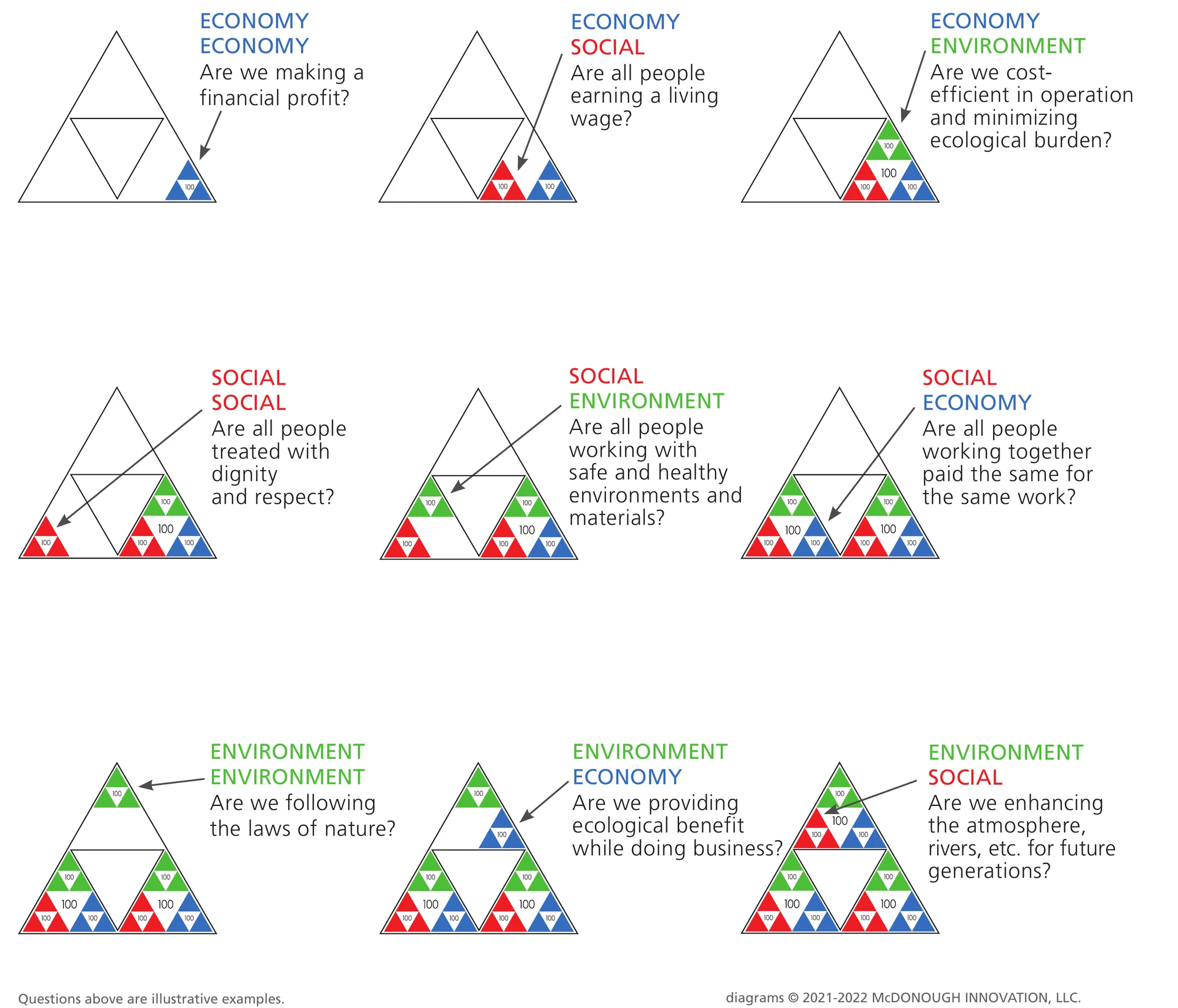
Enterprises of all kinds can design using the McDonough Design Framework, recognizing all stakeholders, not just shareholders. It is a design tool based on environmental, social, and economic principles connected by coherent governance. The goal is to scrutinize and optimize all values represented by the triangle, to render the information visible, and to encourage constant improvement.
- Illustrative questions
- Economy · Economy
- Are we making a financial profit?
- Economy · Social
- Are all people earning a living wage?
- Economy · Environment
- Are we cost-efficient in operation and minimizing ecological burden?
- Social · Social
- Are all people treated with dignity and respect?
- Social · Environment
- Are all people working with safe and healthy environments and materials?
- Social · Economy
- Are all people working together paid the same for the same work?
- Environment · Environment
- Are we following the laws of nature?
- Environment · Economy
- Are we providing ecological benefit while doing business?
- Environment · Social
- Are we enhancing the atmosphere, rivers, etc. for future generations?
Waging Peace · pp. 7–8
Cradle to Cradle Design™
Three principles from nature
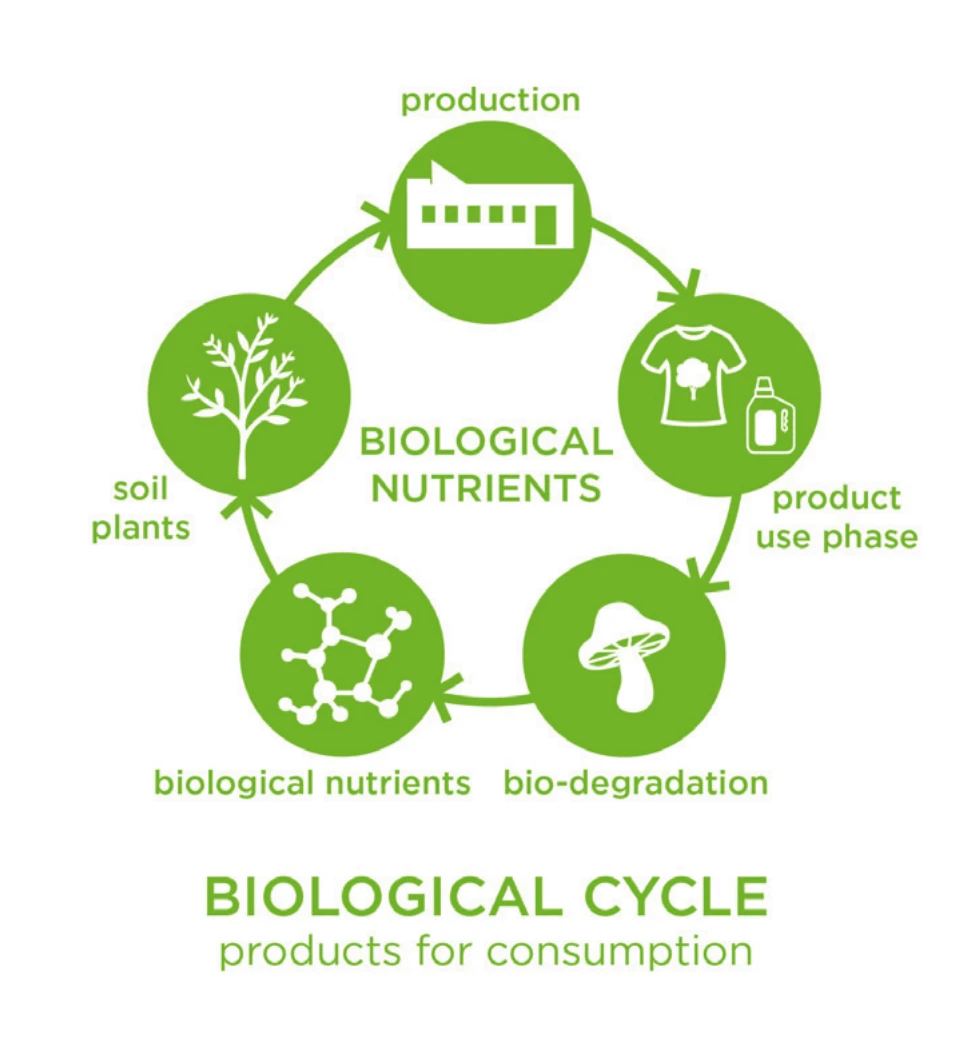
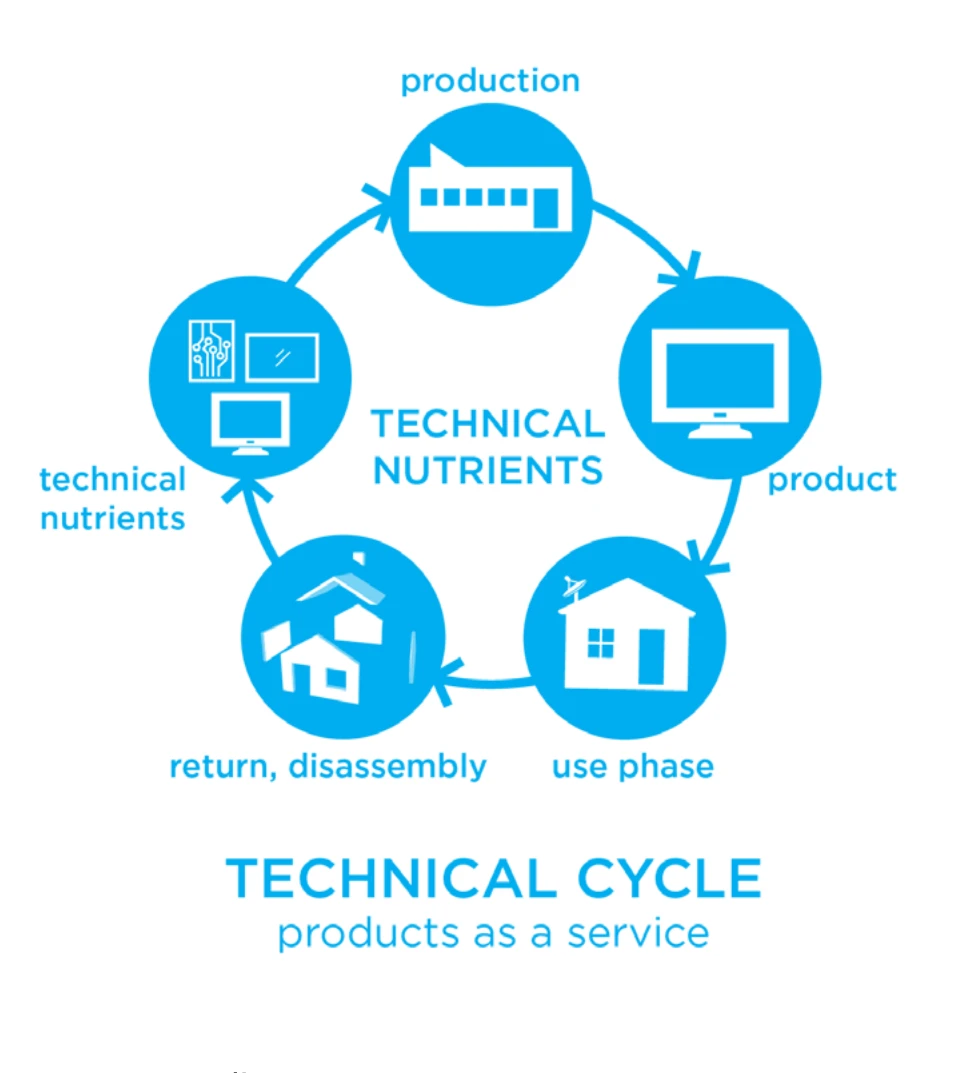
In their 2002 book, Cradle to Cradle: Remaking the Way We Make Things, architect William McDonough and chemist Michael Braungart presented a science-based design framework that eliminates the concept of waste and provides enduring benefits for society, from safe materials and circular economies to clean air, water and energy.
- Three principles derived from nature
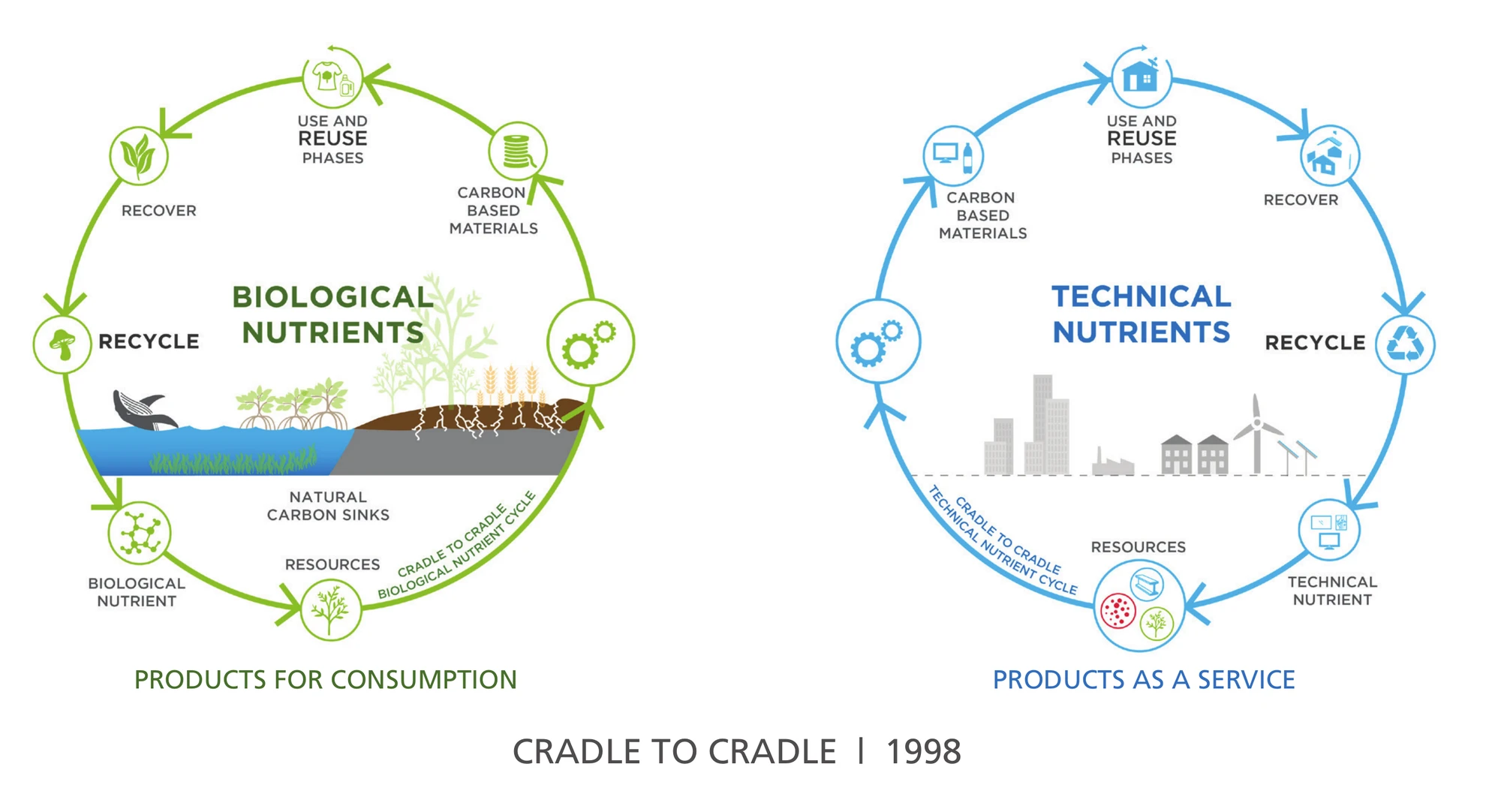
- Everything is a resource for something else
- In nature, the "waste" of one system becomes food for another. Everything can be designed to be disassembled and safely returned to the soil as biological nutrients, or reutilized as high-quality materials for new products as technical nutrients without contamination.
- Use clean and renewable energy
- Living things thrive on the energy of current solar income. Similarly, human constructs can utilize clean and renewable energy in many forms, such as solar, wind, geothermal, gravitational energy and other energy systems being developed today, thereby capitalizing on these abundant resources while supporting human and environmental health.
- Celebrate diversity
- Around the world, geology, hydrology, photosynthesis and nutrient cycling, adapted to locale, yield an astonishing diversity of natural and cultural life. Designs that respond to the challenges and opportunities offered by each place fit elegantly and effectively into their own niches.
Rather than seeking to minimize the harm we inflict, Cradle to Cradle reframes design as a positive, regenerative force, one that creates footprints to delight in, not lament. This paradigm shift reveals opportunities to improve quality, increase value and spur innovation. It inspires us to constantly seek improvement in our designs, and to share our discoveries with others.
View in the book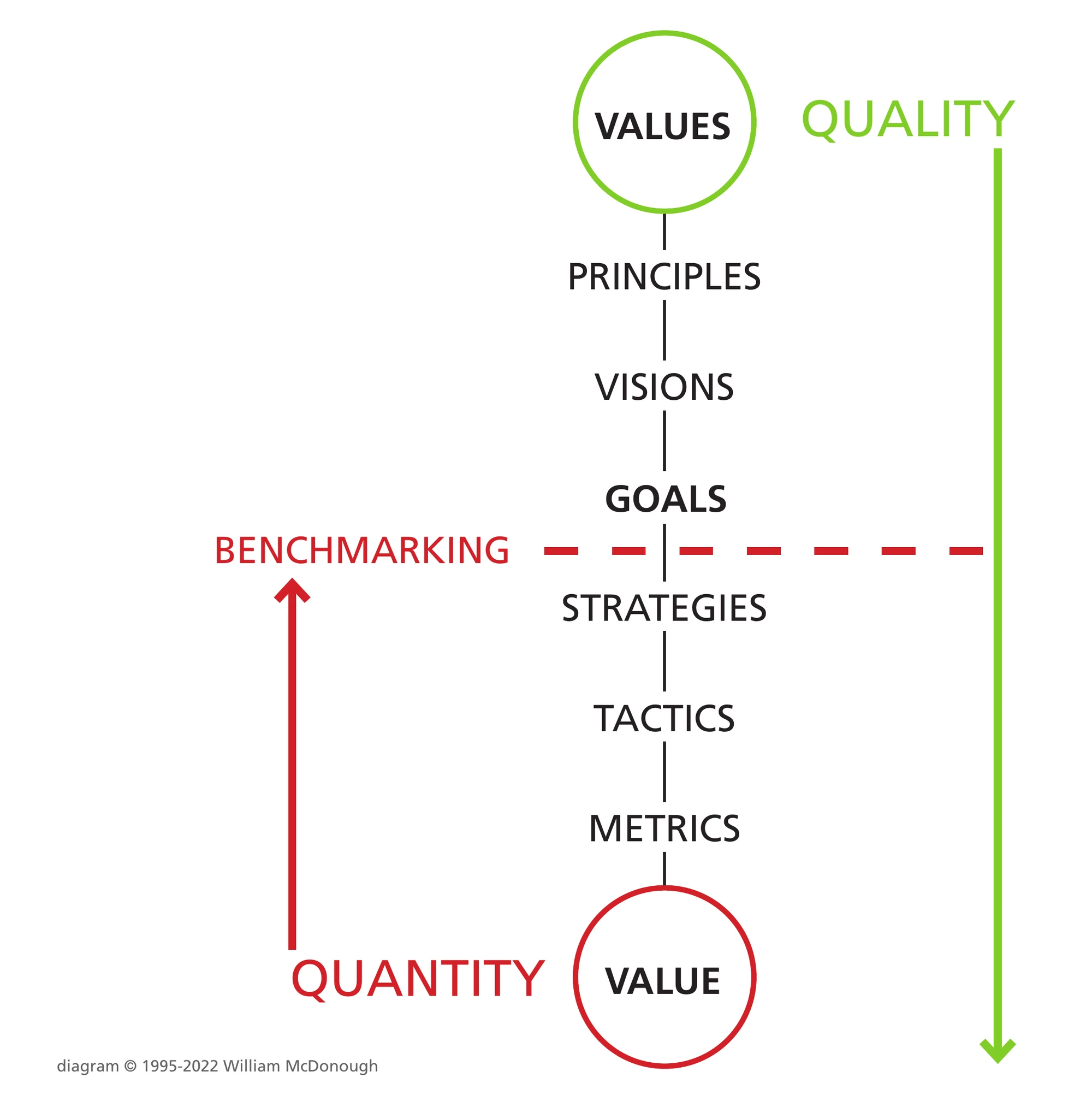
Waging Peace · pp. 9–10
From Values to Value™
From quality to quantity
Using a design lens and multi-disciplinary approach, we work with our clients to innovate new systems and solutions for some of the toughest challenges they face. Our process begins with your values.
- The sequence
- Values
- What's your "Compass"?
- Principles
- Against what fulcrum do you lean your levers of change?
- Visions
- What does the desirable future look like to you?
- Goals
- What do you want to achieve that gets you up in the morning?
- Strategies
- Where do you desire to move the world? What is your plan? What is your lever?
- Tactics
- What do you do every day to pursue your goals or express your values?
- Metrics
- How do you measure success? What do you consider statistically significant?
- Value
- Have you made positive contributions to the world and future generations?
Waging Peace · pp. 11–12
The Five Goods™
A Design Positive Framework™, inspired by Cradle to Cradle
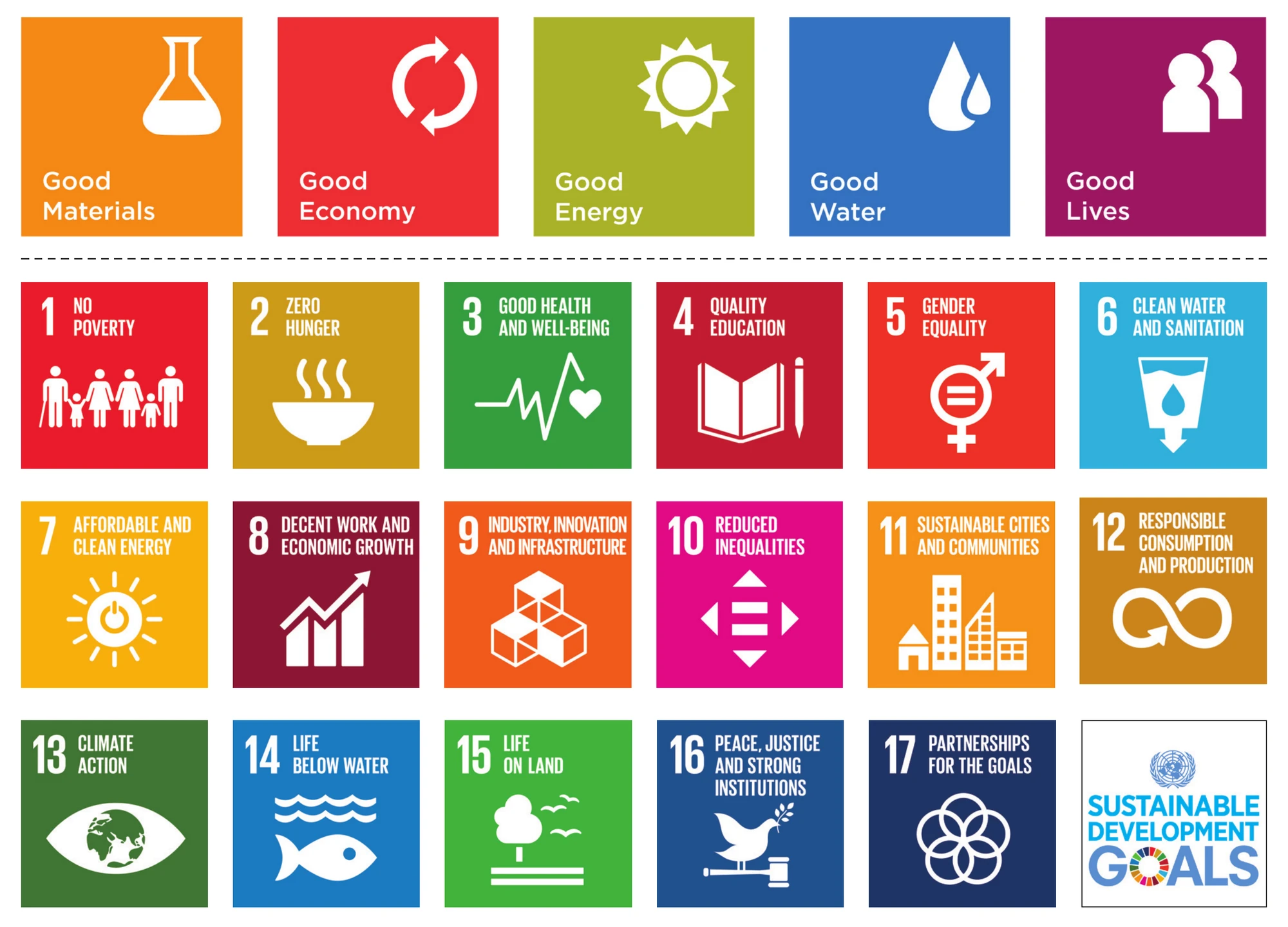
Using the intellectual and practical filters of Cradle to Cradle, design solutions are viewed as an aggregation of nutrient metabolisms, energy and water flows, and cultural and ecological biodiversity. The approach is articulated through five categories of positive development.
- Five categories of positive development
- Good Materials : Safe, healthy, biological and technical nutrients
- Ideally, everything that went into a product would be beneficial not just for the product itself, but also for human and ecological health. Companies wouldn't have to work at reducing harmful inputs because they wouldn't include those inputs to begin with.
- Good Economy : Circular, sharing and shared
- When companies finish using or reusing a product, they would ideally break it up into valued resources flowing in a continuous loop of natural and human activity. Nothing would get wasted.
- Good Energy : Clean and renewable
- The goal here is to rely on energy that sustains resources rather than consumes them and/or endangers people. Instead of fossil fuels that take carbon from the ground and release it into the atmosphere, or nuclear power that generates harmful byproducts, companies can use renewable sources that leave the world as well endowed as before.
- Good Water : Clean and available
- The aspiration is a process that leaves water supplies as good as or better than they were before, ideally at drinking water quality. Each process stage would use only readily available water, and leave that water so clean that it can be continually reused or released for the benefit of the surrounding community or ecosystem.
- Good Lives : Safe, creative and dignified
- We'd like our economy to be good not just in the materials, but also in how it treats the people who make it function. Ideally it would promote individual human dignity, with safe working conditions and accommodation for family living circumstances. It would also promote fairness in wages and prices.
The Sustainable Development Goals: when companies start from a Five Goods mindset, they can design their products and processes upfront to promote holistic goodness. This approach provides a framework to achieve progress toward all the Sustainable Development Goals.
View in the book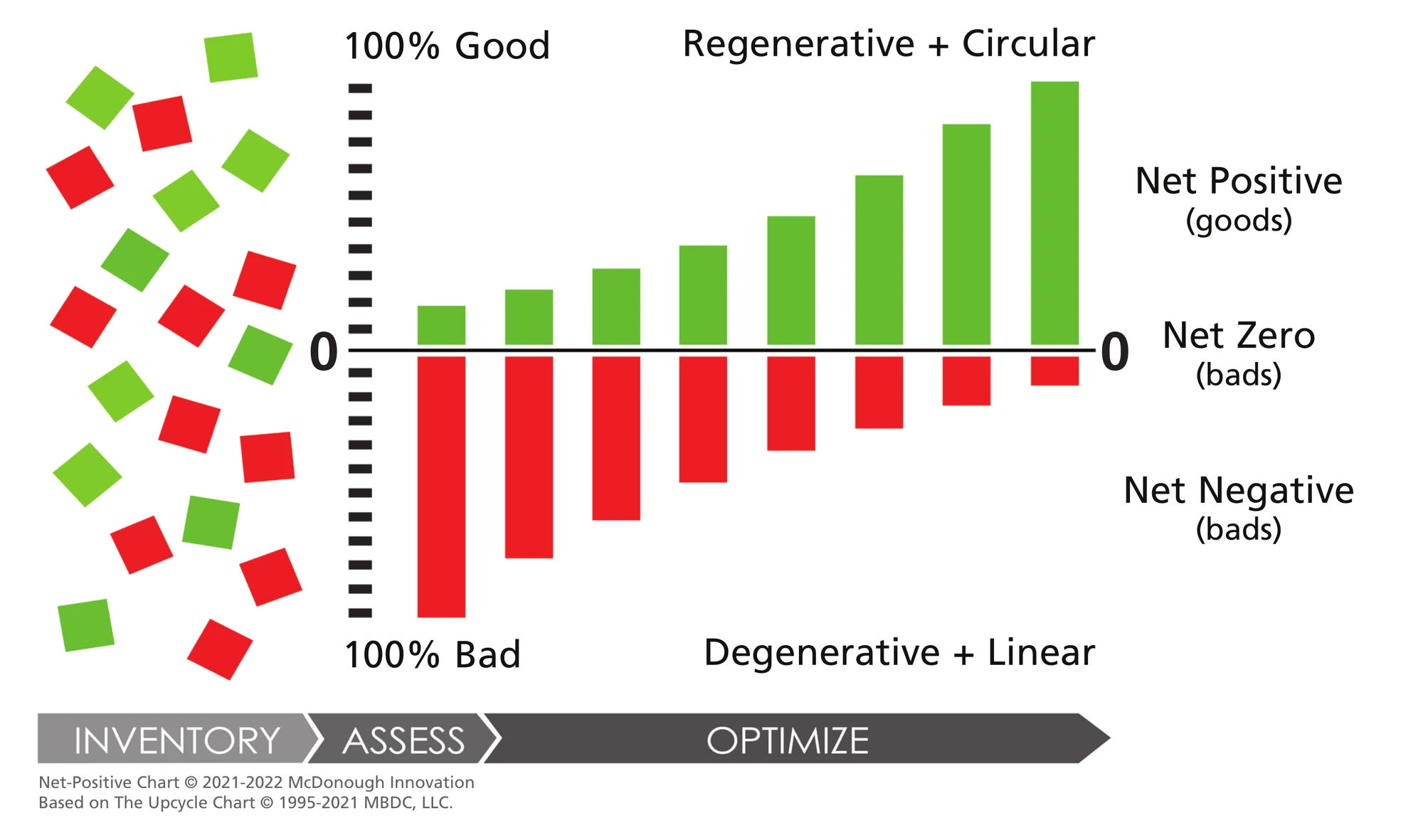
Waging Peace · pp. 13–14
Achieving Net Positive
The Upcycle
Drawing on a decade of lessons in putting Cradle to Cradle Design™ concepts into practice around the world, McDonough and Braungart's book, The Upcycle: Beyond Sustainability, Designing for Abundance, published in 2013, presents a persuasive and inspiring argument for moving beyond conventional approaches to sustainability that seek to merely minimize damage to the environment and human health. By adopting Cradle to Cradle values and principles, and seeking continuous improvement, companies are able to direct innovation in a coherent and positive trajectory.
- Two trajectories
- Eco-Efficient Approach : "Less Bad" trajectory
- Reduce carbon; minimize chemicals of concern; energy efficient; reduce water consumption; goal of zero hazards.
- Eco-Effective Approach : "More Good" trajectory
- Increase positive ingredients; energy positive; improved water quality; increased biodiversity; goal of 100% positive / beneficial products, processes and systems.
The Net-Positive Chart enables many industry sectors, including product manufacturers, to 1) inventory, 2) assess and then 3) optimize products, processes and systems with positive intentions and beneficial goals.
View in the book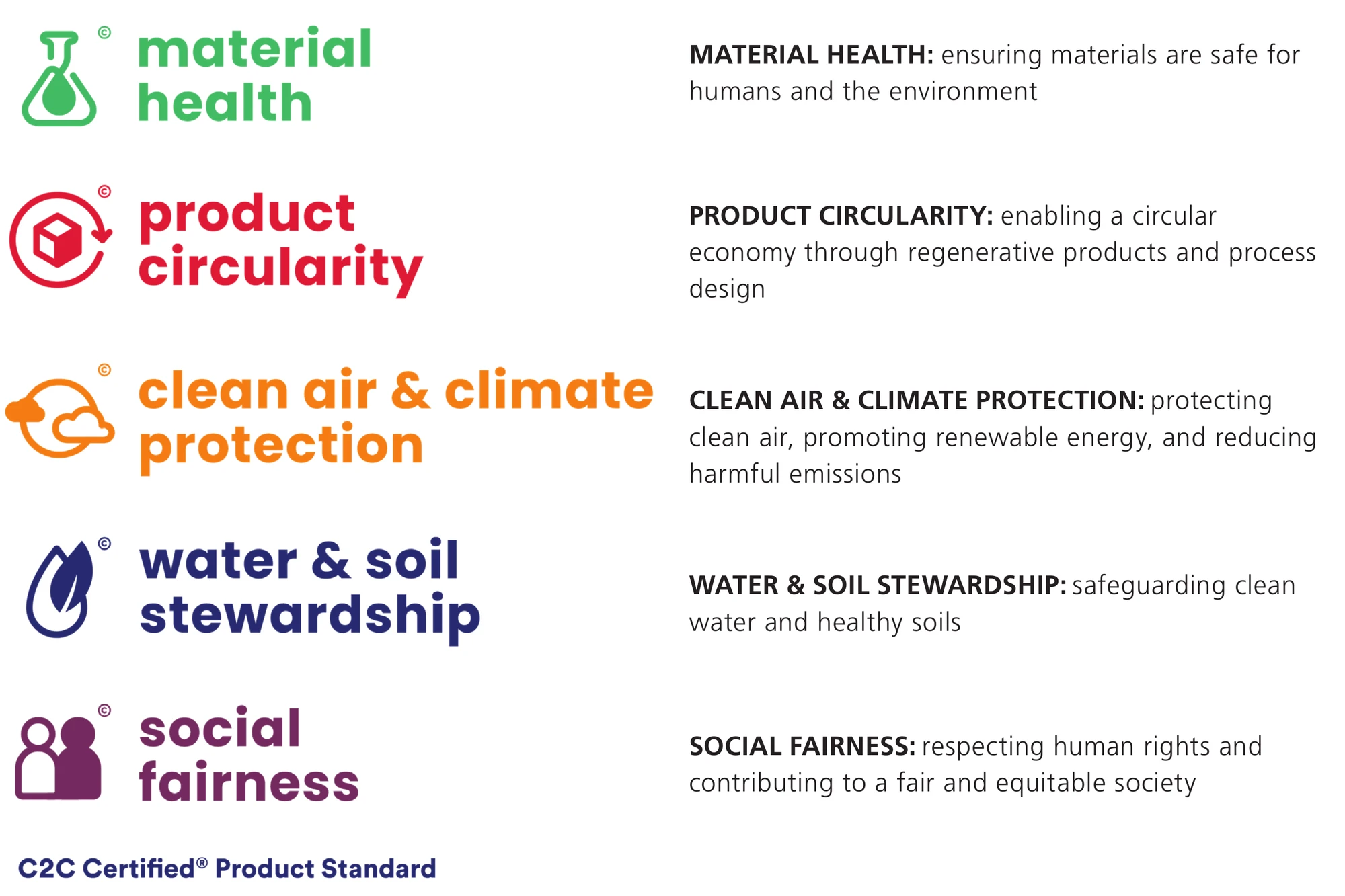
Waging Peace · pp. 15–16
Cradle to Cradle Certified® Product Standard
A comprehensive one-standard solution
Cradle to Cradle Certified Version 4.0 is a comprehensive one-standard solution for addressing the critical sustainability and circularity objectives that define products made for tomorrow. The multi-attribute product standard continues to be developed, maintained and administered by the Cradle to Cradle Products Innovation Institute, an independent, third-party, not-for-profit organization.
- Five assessment categories
- Material Health : Safe for humans and the environment
- Ensuring materials are safe for humans and the environment.
- Product Circularity : Enabling a circular economy
- Enabling a circular economy through regenerative products and process design.
- Clean Air & Climate Protection : Protecting clean air and climate
- Protecting clean air, promoting renewable energy, and reducing harmful emissions.
- Water & Soil Stewardship : Safeguarding clean water and healthy soils
- Safeguarding clean water and healthy soils.
- Social Fairness : Respecting human rights
- Respecting human rights and contributing to a fair and equitable society.
Waging Peace · pp. 17–18
The Circular Economy Concept
Inspired by Cradle to Cradle
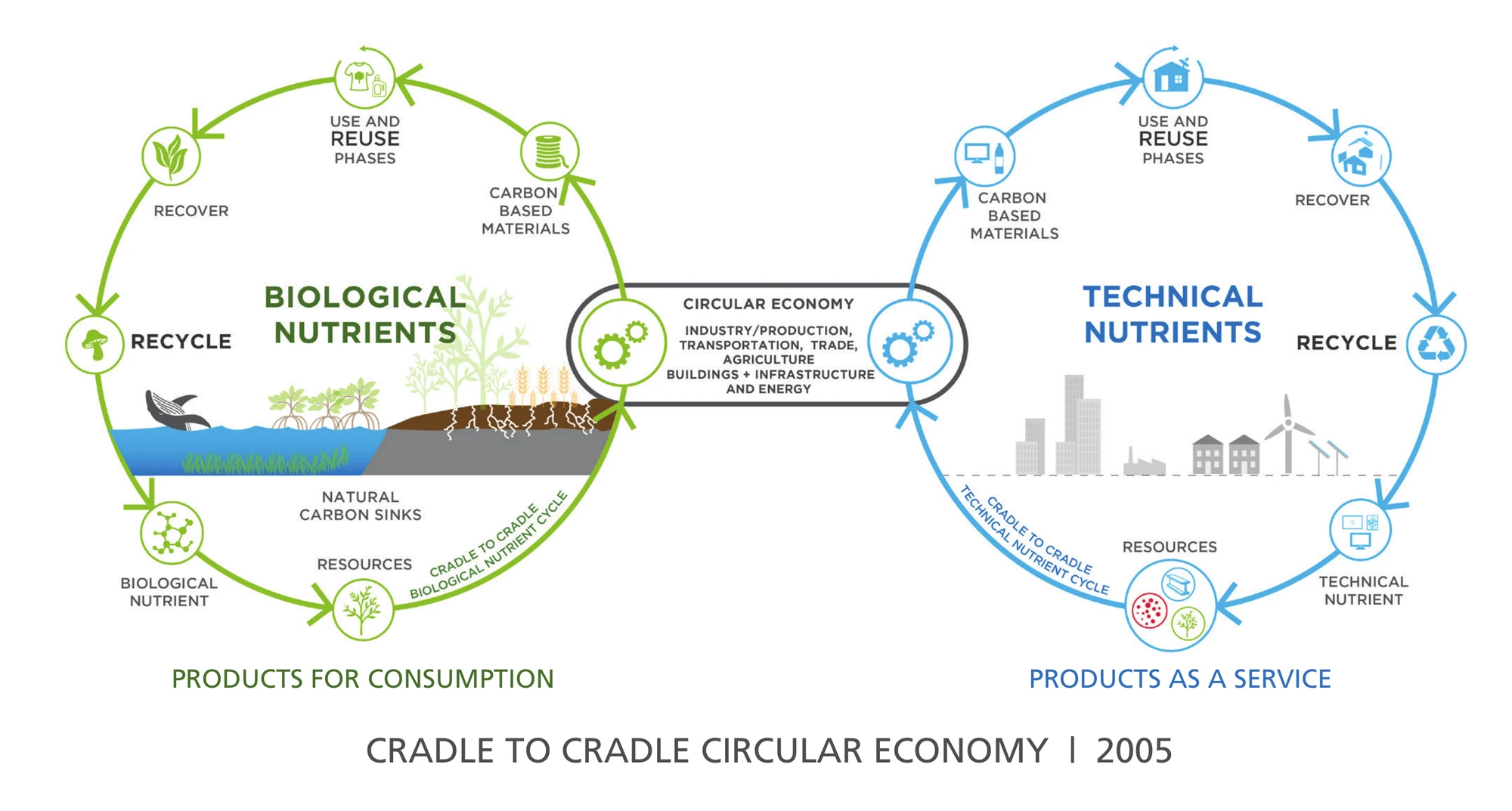
As a model for design at all scales from the molecule to cities and regions, Cradle to Cradle is inspired by nature's principles where waste equals food, clean renewable energy is utilized and diversity is celebrated. The Circular Economy is a resourceful economic system and innovation engine, providing benefits to society in the present and the future. It is designed to continuously recirculate clean materials, energy, water and human ingenuity. In essence, the Circular Economy puts the 're' back in resources. While the Circular Economy is the critical part of the quantification of material flows, Cradle to Cradle calls for a safe then circular qualification of materials, processes and practices first, moving from linear to regenerative 'circular' systems of biological and technical nutrient production and logistics and avoiding the recirculation of harmful chemistry.
View in the book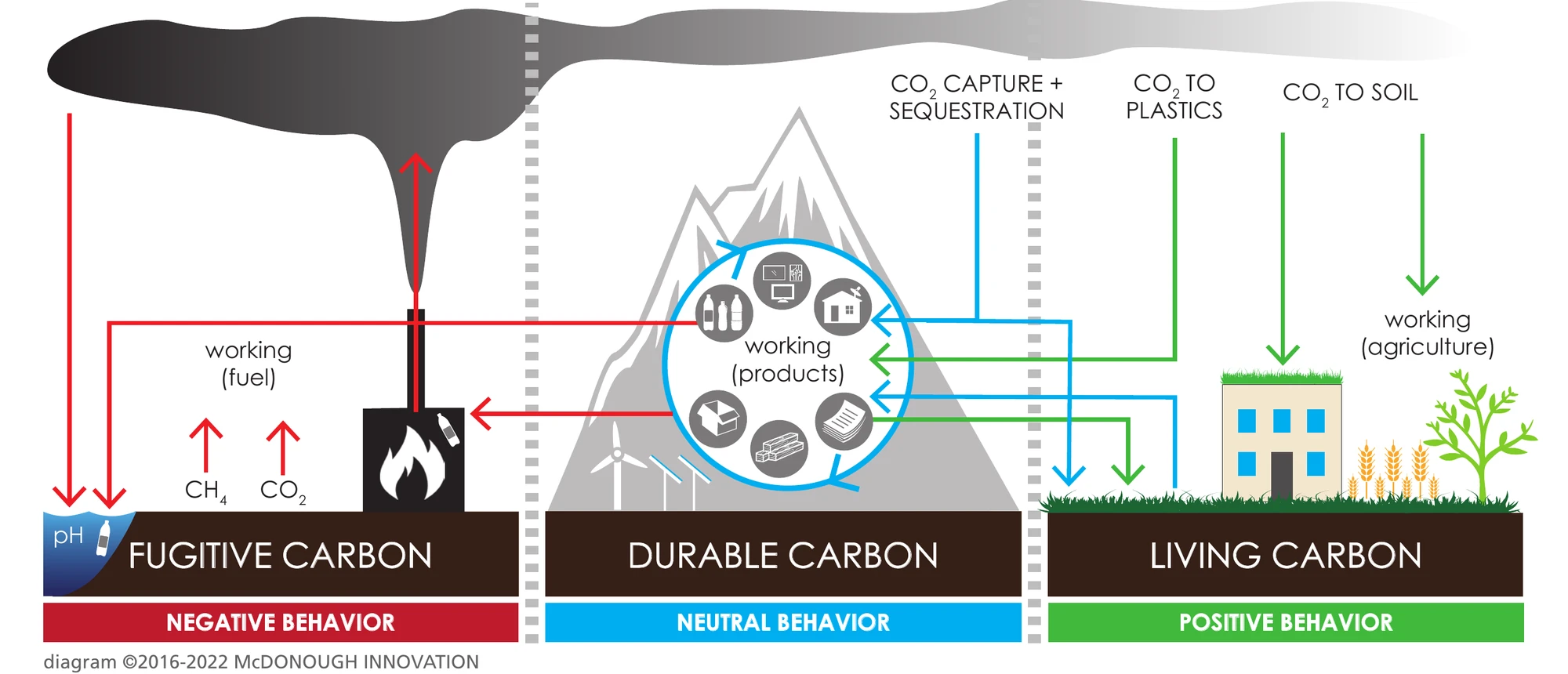
Waging Peace · pp. 21–22
A New Language for Carbon
Carbon Is Not the Enemy · Nature, November 2016
William McDonough has developed a New Language for Carbon that seeks to clarify the terms typically used to describe efforts to reduce carbon emissions and define new, innovative ways in which carbon can be used safely, productively and profitably. In this new paradigm, which was originally published in Nature, the life-giving carbon cycle becomes a model for human designs, enabling us to cultivate urban food systems and closed-loop flows of durable materials in which carbon is an asset rather than a liability. Carbon is not the enemy. Climate change is the result of breakdowns in the carbon cycle caused by us: it is a design failure. Anthropogenic greenhouse gases in the atmosphere make airborne carbon a material in the wrong place, at the wrong dose and wrong duration. It is we who have made carbon a toxin, like lead in our drinking water. In the right place, carbon is a resource and tool. The world's current carbon strategy aims to promote a goal of zero. Predominant language currently includes words such as “low carbon,” “zero carbon,” “negative carbon” and even a “war on carbon.” The new language signals positive intentions, leading us to do more good rather than simply less bad.
- Three categories of carbon, and three behaviors
- Living Carbon : Positive behavior
- Organic, flowing in biological cycles, providing fresh food, healthy forests and fertile soil; something we want to cultivate and grow. Positive behavior: actions converting atmospheric carbon to forms that enhance soil nutrition or to durable forms such as polymers and solid aggregates; also recycling of carbon into nutrients from organic materials, food waste, compostable polymers and sewers.
- Durable Carbon : Neutral behavior
- Locked in stable solids such as coal and limestone or recyclable polymers that are used and reused; ranges from reusable fibers like paper and cloth, to building and infrastructure elements that can last for generations and then be reused. Neutral behavior: actions that transform or maintain carbon in durable Earth-bound forms and cycles across generations; or renewable energy such as solar, wind and hydropower that do not release carbon.
- Fugitive Carbon : Negative behavior
- Has ended up somewhere unwanted and can be toxic; includes carbon dioxide released into the atmosphere by burning fossil fuels, 'waste to energy' plants, methane leaks, deforestation, much industrial agriculture and urban development. Negative behavior: actions that pollute the land, water and atmosphere with various forms of carbon, for example, CO2 and methane into the atmosphere or plastics in the ocean.
Working carbon is a subset of all three categories and defined as a material being put to human use. For example, working living carbon is cultivated in agricultural systems. Working durable carbon is recycled, reused and reprocessed in circular technical systems; and working fugitive carbon includes fossil fuels used for power. Offering an inspiring model for climate action begins with changing the way we talk about carbon. Our goal is for all to embrace this new language and work toward a Carbon Positive design framework; and in doing so we may together support a delightfully diverse, safe, healthy and just world, with clean air, soil, water and energy, that is economically, equitably, ecologically and elegantly enjoyed.
View in the book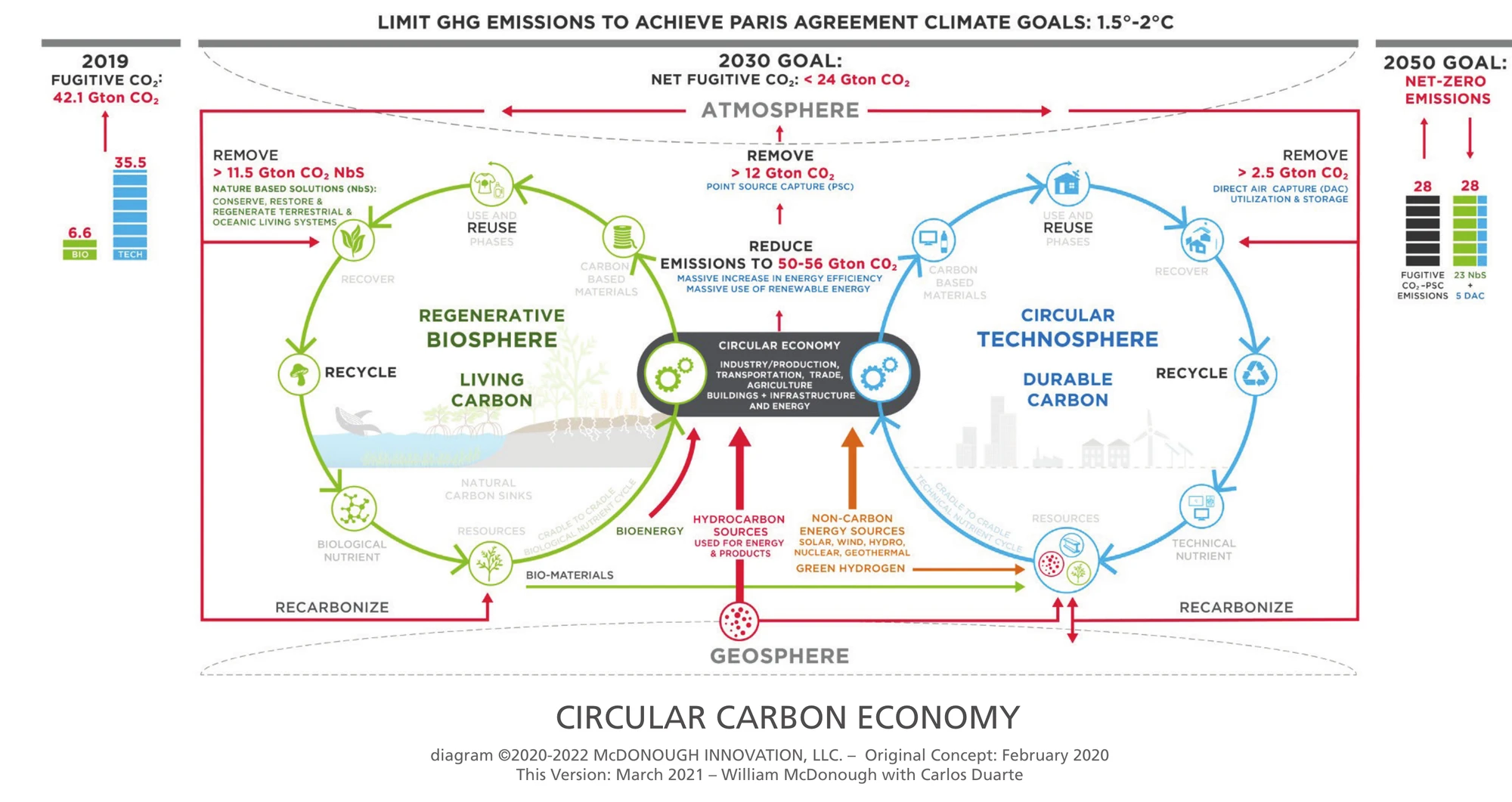
Waging Peace · pp. 23–24
Circular Carbon Economy
Regenerative biosphere and circular technosphere
The Circular Carbon Economy concept serves as a framework for effective carbon management for both carbon-based materials and carbon-based sources of energy. The Circular Carbon Economy recognizes carbon's multiple forms and benefits while defining positive ways for carbon to be used safely, productively and profitably. Guided by Cradle to Cradle Design's biological and technical nutrient cycles, the Circular Carbon Economy is designed to directly address the climate crisis. With these two distinct carbon cycles, the intention is to reduce, reuse, recycle and recover carbon-based materials and hydrocarbon energy sources in ways which eliminate waste, support regenerative growth and restore the Earth's natural abundance and diversity. In this framework, biological nutrients are safely cycled to accrue living carbon into the Regenerative Biosphere while technical nutrients are safely used, reused, recycled and returned to the Circular Technosphere across generations of economic growth and prosperity.
The G20 Presidency invited William McDonough to open the March G20 Climate Stewardship Working Group and Energy Sustainability Working Group meetings by presenting the Circular Carbon Economy concept. McDonough collaborated with marine biologist Carlos Duarte on this concept, which integrates innovative business models of the larger circular economy where carbon is both a valuable material and a valuable energy source. McDonough also provided guidance and contributed to KAPSARC's CCE Guide Overview, published in August 2020, which introduces the concept and serves as an overview of the CCE Guide (www.cceguide.org). In November 2020, world leaders encouraged the use of the Circular Carbon Economy framework. “Building upon Cradle to Cradle and the New Language of Carbon, we can build a framework for carbon materials management that embraces the good intentions of the Three Rs (recycle, reduce and reuse) while seeking to improve upon their performance, adding to the traditional hierarchy new principles to eliminate the concept of waste, enable effective material flows and create a truly sustainable carbon economy that is both safe and circular. To the Three Rs, we add a fourth: Remove. Let us seek to identify, encourage and implement strategies to remove fugitive carbon from our oceans, lands and atmosphere.”
View in the book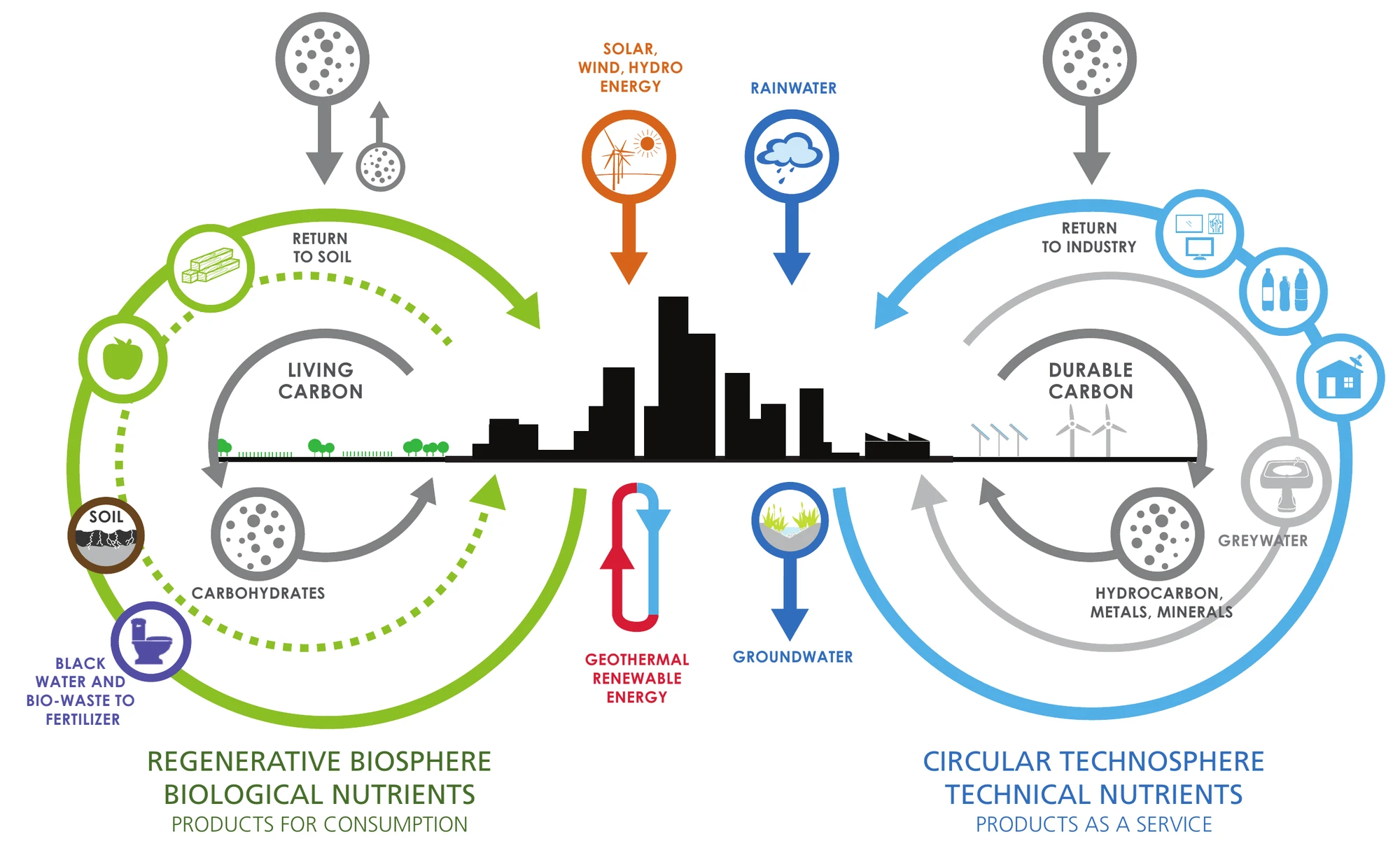
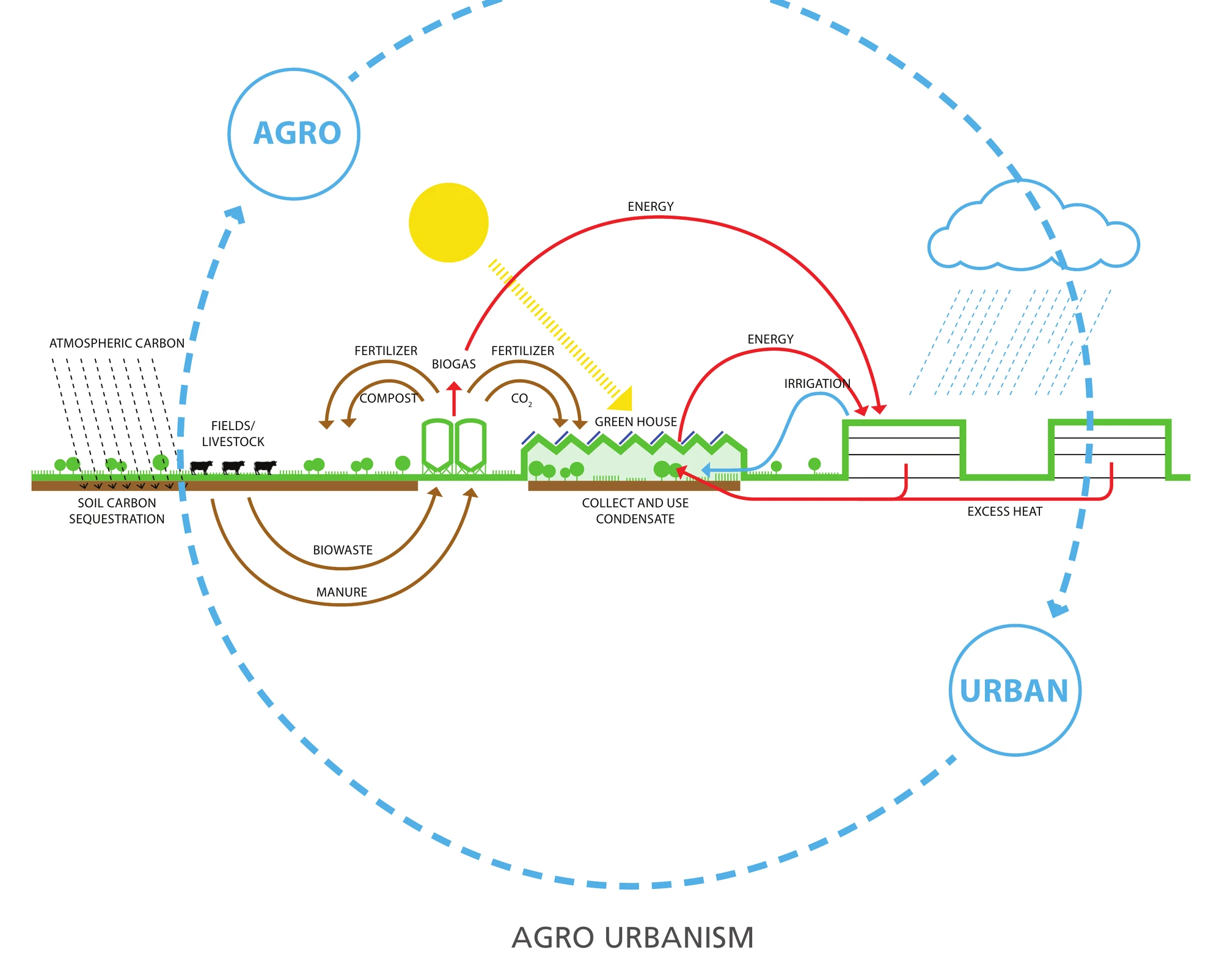 Agro Urbanism
Waging Peace · pp. 25–26
The Net-Positive Carbon City
A city as a living system
William McDonough's concept for the Net-Positive Carbon City brings the new language for carbon into a tangible design framework. The Net-Positive Carbon City integrates agriculture, regenerative land management practices and urban design at a regional and international scale. It recognizes both local and distant effects of cities and envisions a holistic, synergistic system to transform fugitive carbon into durable carbon, such as plastics and building materials, as well as into living carbon, such as healthy soils, gardens, crops and landscapes. City infrastructure adapts to the new idea: for example, sewage treatment plants are reconceived as fertilizer factories and intensive integrated agriculture systems, what we call solar orchards, provide clean energy, clean food, clean water and jobs simultaneously.
View in the bookTalks and conversations
Ideas spoken across decades
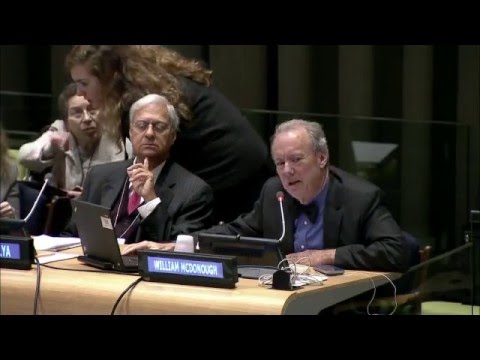
Lectures, interviews, and conversations about design, materials, cities, carbon, and what comes next.


















Listen
The Monticello Dialogues
A series of conversations with William McDonough, recorded at Monticello and broadcast by New Dimensions Radio, exploring design, democracy, and what it means to make things well.
Writings
The ideas in their original form
- 1974EssayThe Elm City DinerAn essay and sketch of the Elm City Diner in New Haven. Archvark, Volume II, No. 1, March 1974.
- 1989ProfileWill Poland Plant a Forest to Satisfy a U.S. Architect?By Rose Gutfeld. The Wall Street Journal, October 23, 1989: the Warsaw Trade Center, aerobic architecture and a forest to offset its carbon.
- 1990ProfileThe Virtues of VersatilityBy Suzanne Stephens. Architectural Digest, March 1990.
- 1990ProfileArchitectural Detailing in Residential InteriorsBy Wendy W. Staebler. Four residential details by William McDonough Architects.
- 1992PrinciplesThe Hannover Principles: Design for SustainabilityBy William McDonough Architects. Self-published.
- 1993MagazineA Boat for ThoreauBy William McDonough. Business Ethics Magazine, May/June 1993.
- 1993AddressA Centennial Sermon: Design, Ecology, Ethics and the Making of ThingsBy William McDonough. Delivered at the Cathedral of St. John the Divine, New York, February 7, 1993.
- 1998EssayThe NEXT Industrial RevolutionBy William McDonough & Michael Braungart. The Atlantic, October 1998.Watch the film on Vimeo
- 1999Profile1999 Designer of the YearBy Andrea Truppin, with a message from William McDonough. Interiors, January 1999.
- 2000InterviewThe Hopeful InventorsBy Katie Sosnowchik, with William McDonough & Michael Braungart. Green@Work, May/June 2000.
- 2001EssayThe Extravagant Gesture: Nature, Design, and the Transformation of Human IndustryBy William McDonough & Michael Braungart. Sustainable Planet (Beacon Press).
- 2002EssayThe Guardian Reborn: A New Government Role in Environmental ProtectionBy William McDonough & Michael Braungart. The Environmental Future (Woodrow Wilson Center).
- 2002BookCradle to Cradle: Remaking the Way We Make ThingsBy William McDonough & Michael Braungart. Excerpts from the book.
- 2002EssayHow Much Can I Give for What I Get? Reflections on the Transformation of EconomiesBy William McDonough.
- 2002EssayBuildings Like Trees, Cities Like ForestsBy William McDonough & Michael Braungart.
- 2002JournalA Building Like a Tree, a Campus Like a Forest: Sustainable Design, Ecological Literacy, and the Legacy of the New England CampusBy William McDonough, Michael Braungart & Diane Dale. New England Board of Higher Education, Summer 2002.
- 2002EssayA New Geography of Hope: Landscape, Design, and the Renewal of Ecological IntelligenceBy William McDonough & Michael Braungart. Extreme Landscape: The Lure of Mountain Spaces.
- 2002EssayBuildings Like Trees, Cities Like ForestsBy William McDonough & Michael Braungart. TechTV's Catalog of Tomorrow: Trends Shaping Your Future, edited by Andrew Zolli.
- 2002BookPreface: Big & GreenBy William McDonough. Preface to Big & Green: Toward Sustainable Architecture in the 21st Century, National Building Museum.
- 2002green@workWaging Peace with Intelligent DesignBy William McDonough and Michael Braungart. green@work, November/December 2002: what if we waged peace as fiercely as we are prepared to wage war?
- 2003EssayToward a World That Works for EveryoneBy William McDonough with Thomas T. K. Zung and Lord Norman Foster. Draft essays on the legacy of Buckminster Fuller, including the manifesto Form Follows Evolution, for Stanford University's Fuller exhibition.
- 2003JournalRedefining Green: A New Definition of Quality Empowers the Next Wave of DesignBy William McDonough & Michael Braungart. EnvironDesign Journal, Spring 2003.
- 2003JournalBeyond the Triple Bottom Line: A New Standard for 21st Century CommerceBy William McDonough & Michael Braungart. GreenMoney Journal, June/July 2003.
- 2003EssayCelebrating Human ArtificeBy William McDonough.
- 2003EssayA Field of Dreams: Green Roofs, Ecological Design and the Future of UrbanismBy William McDonough.
- 2003BookSomething Lived, Something Dreamed: Urban Design & the American WestBy William McDonough. Red Butte Press.
- 2003TalkScience in a Crowded WorldRemarks by William McDonough at the symposium dedicating the Woods Hole Research Center's Ordway Campus. Buildings for the New Century.
- 2003ForewordForeword: Leading Change toward SustainabilityBy William McDonough. Leading Change toward Sustainability: A Change-Management Guide for Business, Government and Civil Society, by Bob Doppelt.
- 2003UNEPTowards a Sustaining Architecture for the 21st Century: The Promise of Cradle-to-Cradle DesignBy William McDonough and Michael Braungart. UNEP Industry and Environment, April–September 2003: from eco-efficiency to rematerialization, intelligent materials pooling, and buildings, towns and villages designed as nutrient cycles.
- 2003green@workDesign for the Triple Top LineBy William McDonough and Michael Braungart. green@work, January/February 2003: a new definition of quality, the fractal triangle, and the shift from the triple bottom line to the triple top line.
- 2003The Chronicle of Higher EducationToward a 21st Century Renaissance: Education, Design and a Hopeful Human ProspectBy William McDonough. What it would mean for universities to prepare the designers of the twenty-first century world.
- 2003Talking Point (BP)Toward a Future of Energy EffectivenessBy William McDonough. Beyond eco-efficiency: why slowing down is not the same as changing direction, and what an energy-effective industry could be.
- 2004ForewordForeword: The Natural Advantage of NationsBy William McDonough. The Natural Advantage of Nations.
- 2004Detroit Free PressA New Era for ManufacturingBy William McDonough. The reopening of Ford's River Rouge plant as a model of 21st century sustainable manufacturing.
- 2005ForewordForeword to the Chinese edition of Cradle to CradleBy William McDonough & Michael Braungart. Cradle to Cradle: Design for the Circular Economy.
- 2004PrefacePreface: Sustainable Development and SocietyBy William McDonough. Preface to Sustainable Development and Society, GSA Office of Governmentwide Policy, October 2004.
- 2004GSAThe Ecology of Sustainable DesignBy William McDonough. Sustainable Development and Society, GSA Office of Governmentwide Policy, October 2004: cradle to cradle materials, the fractal triangle, and multiple positives at Herman Miller and Ford.
- 2004Solar TodayA Declaration of Interdependence: Jefferson, Design and the Future of Solar ArchitectureBy William McDonough. Solar Today, November/December 2004: Jefferson as designer, the end of oil hegemony, and a solar architecture in dialogue with landscape.
- 2004TIMEThink GreenBy William McDonough. TIME, November 1, 2004, The Road Ahead: in building and product design, what if we thought galactically and acted molecularly?
- 2005ForewordGreen Roofs, Ecological Design and the Future of UrbanismBy William McDonough. Foreword to Green Roofs: Ecological Design and Construction, Earth Pledge (Schiffer).
- 2006Harvard Business ReviewChina as a Green LabBy William McDonough. Harvard Business Review, February 2006, The HBR List: Breakthrough Ideas for 2006.
- 2006FortuneDesign for LivingBy William McDonough. Fortune, November 13, 2006, The Future of Design: a building like a tree, standing in a city like a forest.
- 2010EssaySailing Toward a Strategy of Hope in the Land of Many Colored ThingsBy William McDonough. On the Plastiki expedition, the plastics in the ocean, and the ancient Irish voyage to the Land of Many Colored Things.
- 2012ConversationEndless Resourcefulness: A Conversation About WaterWilliam McDonough in conversation with editor Karl Weber on water as a currency of endless resourcefulness, from Hong Kong's water crises to the NASA Sustainability Base.
- 2013BookThe Upcycle: Beyond Sustainability, Designing for AbundanceBy William McDonough & Michael Braungart. Excerpts from the book.
- 2013Huffington PostEarth DaysBy William McDonough & Wendy Schmidt. Huffington Post, April 19, 2013.
- 2013The GuardianDriving Sustainable Transformation via the Power of DesignBy William McDonough. The Guardian, August 19, 2013.
- 2014BookA Strategy of HopeBy William McDonough. Global Chorus: 365 Voices on the Future of the Planet, edited by Todd E. MacLean.
- 2014The GuardianDesigning Cities and Factories with Urban Agriculture in MindBy William McDonough. The Guardian, April 23, 2014.
- 2014ForewordForeword: Second Nature Urban AgricultureBy William McDonough. Second Nature Urban Agriculture.
- 2014Huffington PostClean MachineBy William McDonough. Method's South Side Chicago factory as a clean, generative neighbor in the historic Pullman District.
- 2014EssayCycles of Endless ResourcefulnessBy William McDonough. Setting a course for the World Economic Forum’s Meta-Council on the Circular Economy.
- 2015EssayEndless is More: The Circular Economy and Our Path from Values to ValueBy William McDonough. January 16, 2015.
- 2015AlmereThe Growing Green Cities PrinciplesBy William McDonough + Partners with the City of Almere, July 2015: the Almere Principles revisited for the Floriade 2022, from garden cities to green cities, and starting points for area development.
- 2015ForewordFashion Is a VerbBy William McDonough. Sustainable Fashion: What's Next, 2nd Edition, by Janet Hethorn and Connie Ulasewicz (Bloomsbury).
- 2015EssayThe Republic of InventionBy William McDonough. From the collaborative authorship of the Declaration of Independence to a Republic of Invention working for the common wealth.
- 2016NatureCarbon Is Not the EnemyBy William McDonough. Nature, November 14, 2016.
- 2017EssayThe Pollution CenturyBy William McDonough. Imaginal Cells: Visions of Transformation, by Kim Polman.
- 2017Scientific AmericanDesigning the City of Tomorrow: How Cities Could Save UsBy William McDonough. Scientific American, July 2017.
- 2017PoemTowards a New Language of LuxuryBy William McDonough. A poem, as presented in Brussels, November 13, 2017: design is the first signal of intention. How can something be beautiful if it damages children’s health?
- 2019BookletImagine a CityBy William McDonough. A bilingual English and Chinese booklet: imagine a city where waste does not exist, that grows its food, makes its energy, cleans its water and celebrates ancient species.
- 2022OpinionA Tale of Two WorldsBy William McDonough. Opinion essay on the biosphere and the technosphere.