
Imaginal Cells: Visions of Transformation, curated by Kim Polman and Stephen Vasconcellos-Sharpe (Reboot the Future), Chapter 13
The Pollution Century
By William McDonough.
Our household is a mess. As 795m people go hungry, a third of our food is wasted: waste that accounts for $940bn in annual economic losses, requiring one quarter of all the water used by agriculture; cropland the size of China; and generating roughly 8% of global greenhouse emissions.
Much of that food itself comes wrapped or boxed in plastic which leaks into the ocean at a rate of 8m tonnes a year, joining the 150m tonnes already floating off our shores.
At current rates, the amount of all ocean-borne plastic will likely outweigh all the fish in the sea by the year 2050. This tide of waste drains our economies, too. Nearly 95% of the material value of all that plastic packaging, roughly $120bn annually, is lost after its first and only use.
While billions enjoy the many benefits of sustained economic growth, the industrial system upon which we depend has disrupted and polluted the Earth.
The past century will be dubbed the ‘Pollution Century’. Often, it was said, the solution to pollution was dilution, simply sending our toxins into water to be diluted.
But in dealing with this chaos today, we must do more than simply limit the negative impacts of industry and circulating toxic materials. We must move to a healthy, productive system where growth is valued and there is no such thing as waste.
Trying to be “less bad”, to reduce or minimise the impact of industry and commerce, is a common strategy in conventional business. But if your goal is just to reduce your impact or get to zero (zero waste, zero carbon, zero emissions), you are only defining what you don’t want, not asking what you might create “for the benefit of all”.
Let’s face it, we are all carbon-based life-forms. If the goal is only to use 20% less carbon, you might as well cut your own leg off.
Instead, why not strive to have a positive, beneficial impact on the planet with a virtuous economy, rather than being less bad within a destructive system?
Good design allows us to do that by following the laws of nature. Rather than limit growth, we can grow in ways that replenish, restore and nourish the world.
There are many things we all want to grow. Education, health, opportunity, more clean water, fresh air, healthy food and shared prosperity. Whatever positive aspiration we might pursue, design gives us the capacity to cultivate good, regenerative growth: making the world better because we are here.
The circular economy doesn’t simply minimise waste: it eliminates the very concept of waste and establishes cycles of endless resourcefulness.
The economic benefits are substantial. A 2013 study by McKinsey & Company estimated that a transition to the circular economy in the European Union would provide $1tn in annual savings by 2025 and create 100,000 jobs within five years.
Recently, I have been working on a project to replace steel and wood with more modest items to aid those in poorer societies, by considering how to make building materials from disused plastic.
We are in the middle of reinforcing discarded plastics to make them ultra stable, strong and durable, while working with four companies across Brazil, Chile, Colombia and Mexico.
I have also spent considerable time studying the trash heaps of the world and looking how to mine them for useful effect. This approach is combined with looking at what is discarded, so that we can get signals for how to redesign what goes to waste in the first place. Over the next few decades I can envisage a situation where we remove the antimony from plastic bottles made of polyethylene terephthalate (known as PET).
Could we even reach a situation where plastic is reclaimed for its value? To evaluate this statement, we must ask ourselves if the outcome could see reclaimed plastics worth more than oil and methane?
Certainly the rise of solar energy, which is now being produced more cheaply than gas, is a prime example of how an embryonic industry can develop. Solar has become commoditised in the past decade after the Germans built a market for it and the Chinese worked to commercialise it.
So we could certainly see the same happening with polymers, which may be seen as high value materials if they can be designed with that purpose in mind.
The Golden Rule is a call for intergenerational compassion, calling on us to “do unto your children as they would have you do unto them.”
The next century must be the ‘Ecological Century’. We can ask these design questions that inspire our creativity and generate tremendous value. How can this project make a positive difference in the life of the local community? How might it create habitats, nourish the landscape, and restore biodiversity? How much shared prosperity can we grow? That is how we wage peace through commerce.
The German chemist Michael Braungart and I first posited this values-based design framework to chart a path of continuous improvement with regenerative, circular flows of safe, valuable materials, energy, water and social benefit in ‘Cradle to Cradle: Remaking the Way We Make Things’ (2002).
Our first principle, ‘insist on the right of humanity and nature to exist in a healthy, diverse and sustainable condition’, declared our intention to build relationships (whether between buildings and places, or companies and the sources of their wealth) that support the well-being of all living things. Among the other key principles was that design is the first signal of human intention.
Our work was modelled on the nutrient flows of natural systems. In nature, the processes of every organism contribute to the health of the whole. One organism’s “waste” becomes food for another, and the fundamental nutrients that support life flow perpetually in regenerative cycles of birth, decay and rebirth: everything is food.
This shows products can be conceived as biological nutrients, products of the biosphere, which are designed to be returned to the earth after use: rebuilding the soil and feeding new growth; or as technical nutrients, products of the technosphere, designed to flow in continuous cycles of use, recovery, and re-manufacture, feeding the creative work of industry.
This is far superior to conventional forms of recycling, which typically downgrade and mix incompatible materials and uses, putting materials in the wrong hands or in the wrong place.
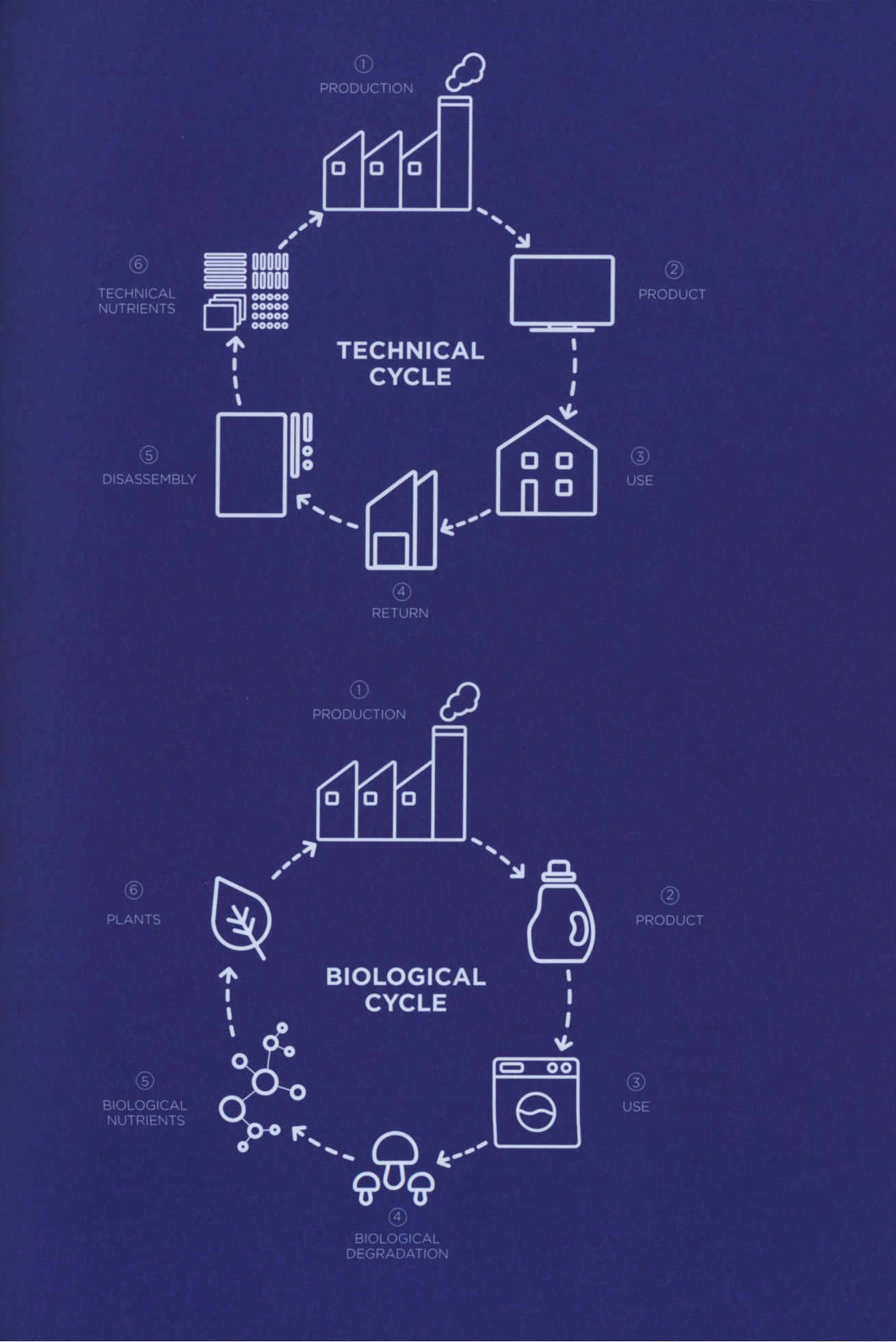
On the manufacturing side, circular strategies allow intelligent companies to put the ‘re’ back into resources sustaining long-term growth, while the products of circular economies fulfil their purpose by providing access to a service. Rather than buying a car, for example, one may choose to buy access to mobility. People can choose products of service for their qualities and performance, while their makers can “retain ownership” of materials so that the product’s embedded quality can be easily recovered and redeployed.
The transition is well underway, worldwide and on multiple scales. Shaw Industries, the world’s largest carpet manufacturer, guarantees the recovery of its Cradle to Cradle Certified carpet tiles, printing a 1-800 number on the back of each tile to facilitate its return.
Having made its product with materials that are healthy and safe, and that retain their value for infinite cycles of use, Shaw gladly answers every call and uses recovered tiles as raw materials for the next generation of carpet, saving $4m annually on water and energy costs in the process. Currently these products designed for the circular economy account for $2.4bn of Shaw’s $4bn annual total sales. Desso, a European carpet maker, has adopted the same strategy.
These early adopters carry unique burdens; true for any major transformation. But an emerging circular economy depends upon well-organised collaboration, extending throughout supply chains and across national borders, realising the opportunity of cooperation at a depth and on a scale rarely seen in world affairs... and it is happening.
I have the privilege of working closely with the China Association of the Circular Economy, which is developing China’s next 5-year plan with new government ministers and hundreds of the nation’s largest companies. In Europe, the Netherlands recently established a 3.5km² National Hub for the Circular Economy adjacent to the Amsterdam Airport Schiphol, while the UK-based Ellen MacArthur Foundation and the World Economic Forum have made a significant investment in raising awareness of the circular economy.
These networks represent what the American Founding Fathers like Benjamin Franklin called “systems of public virtue.” Franklin believed people could be encouraged to do things “for the Benefit of Mankind.” As the philosopher Lewis Hyde pointed out, he did not consider himself (or most people) to be especially virtuous, however he thought principles could be and they could be enlisted to create structures or institutions (including markets) through which individuals could contribute to the common good. As Hyde writes, these are systems in which the good is pronounced “ahead of time.”
Where the circular economy is being adopted, systems of public virtue are organised by establishing values-based platforms for innovative, cooperative work and offering individuals, companies, and institutions from many walks of life a valuable opportunity to realise their goals and aspirations, while contributing to the common wealth.
The five principles of becoming beneficial by design, as described by the Cradle to Cradle Certified Products Program, are: material health (products that can safely return to nature or industry in biological or technical cycles), material re-utilisation, clean energy, water stewardship, and social fairness.
Leading companies from nearly every sector of the global economy and enterprises with trillions of dollars in revenue, as well as thousands of start-ups, are working with these ideas every day.
We’re building factories that can not only make these products, but operate in concert with natural systems, making use of the sun, the landscape, and natural flows of fresh air and water to cycle nutrients, power operations, grow food, and create productive, restorative workplaces.
The solar energy company Sun Power is building photovoltaic power fields that perform like working farms: I call them “Solar Orchards”. Arrays of solar panels elevated above the ground become like trees, shading the earth and providing habitat for native grasses, which capture water, nitrogen and carbon, building soil health, and provide food for grazing sheep, which in turn provide wool. By design, a solar power plant’s relationship to its surroundings creates an abundance of benefits: electricity, habitat, soil restoration, water conservation, wool products, manufacturing and farming jobs, fresh vegetables, fibre, protein, and more.
Places such as these offer an inspiring model for 21st century industry. They show that community and company prosperity are closely entwined and that we all benefit when we support each other, future generations, and the natural world.
Having been involved for most of my life in rendering visible the possibilities of good design in projects all over the world, I am hopeful that we can cultivate our interest in the fortune of others even further, to include not just our friends and peers, but other species and future generations.
To do so, we humbly return to our design values, and as we think about them through the lens of compassion, we see that the Golden Rule is not just for now and not just for us; not just for some children and not just for some species; but is a call to intergenerational compassion which might suggest, “do unto your children as they would have you do unto them”: words implicit in the Cradle to Cradle: How do we love all of the children, of all species, for all time?
As a designer, I believe that is the question of our time. One which will require cycles of endless compassion and creativity, as well as cycles of endless resourcefulness. Cultivating abundance, generosity, and hope, rather than fear, limits, and greed. We will wage peace with commerce, reframing its fundamental question from, “How much can I get for how little I give?” to “How much can we give for all we get?”