
Published in Sustainable Development and Society, GSA Office of Governmentwide Policy, October 2004
The Ecology of Sustainable Design
By William McDonough.
For all the benefits that have come from the technological advances of the last century, and there are many, it has become difficult to deny that the practices of conventional architecture and industry often prove to be at odds with economic, ecological and social health. As industry takes, makes, and wastes, using materials in a cradle-to-grave system designed more than a century ago, our air, water and soil, the very fabric of life, bear the consequences.
An architect's material choices also influence human health. Beyond the widespread environmental problems that undermine social well-being, the various ingredients that add up to a building also have invisible, long-term effects on both building occupants and those who manufacture and dispose of architectural materials. Indeed, none of the materials used to make large-scale buildings is specifically designed to be healthful for people. Even a cursory inventory begins to suggest some of the challenges architects are dealing with.
Consider, for example, the ubiquitous use of polyvinyl chloride. Polyvinyl chloride, better known as PVC or vinyl, is a common ingredient in windows, doors, flooring, wall-coverings, interior surfaces, and insulating materials. Many formulations of PVC have been known to contain toxic heavy metals and plasticizers that are carcinogenic and endocrine disrupting. Equally common is formaldehyde (a reproductive toxin found in particleboard, paints, and textiles) and other volatile organic compounds (VOCs), some of which are suspected carcinogens and immune-system disrupters that occur in adhesives and carpets. Formaldehyde and VOCs seep, or off-gas, from architectural materials, accumulating in tightly sealed buildings in concentrations that make indoor air quality on average three times worse than the most noxious urban air. The forced flow of chemicals through inadequate ventilation systems adds up to costly health problems, like those associated with Sick Building Syndrome.
Fortunately, an expanding palette of materials is allowing designers to phase out the use of polyvinyl chloride and other toxic substances, a very promising step for twenty-first century architecture.
Cradle to Cradle Design
The destructive qualities of today's cradle-to-grave system are fundamentally a deeply ingrained design problem, not an inevitable outcome of human activity. Indeed, good design can transform the making of things (from products to buildings to community plans) into a positive, regenerative force. Based on principles observed in nature, this new conception of design goes beyond retrofitting the systems of architecture and industry to simply reduce their harm. It offers instead a profoundly effective alternative, a framework in which the regenerative, cradle-to-cradle cycles of nature (nutrient cycles, water cycles, energy flows) are seen as both the model for and the context of human designs. Within this cradle-tocradle framework, design can generate wholly positive effects whose benefits enhance all life, allowing us to imagine and create architectural and industrial systems that purify air, land and water, use current solar income and generate no toxic waste, use materials that replenish the earth or can be perpetually recycled.
Over the past decade, the cradle-to-cradle framework has evolved steadily from theory to practice. In the world of industry it is creating a new conception of materials and material flows. Just as in the natural world, in which one organism’s “waste” cycles through an ecosystem to provide nourishment for other living things, cradle-to-cradle materials circulate in closed-loop cycles, providing nutrients for nature or industry. The cradle-to-cradle model recognizes two metabolisms within which materials flow as healthy nutrients.
Nature's nutrient cycles comprise the biological metabolism. Materials designed to flow optimally in the biological metabolism, known in the cradle-to-cradle model as biological nutrients, can be safely returned to the environment after use to nourish living systems. The technical metabolism, designed to mirror the earth’s cradle-to-cradle cycles, is a closed-loop system in which valuable, high-tech synthetics and mineral resources, what German chemist Michael Braungart calls technical nutrients, circulate in a perpetual cycle of production, recovery, and remanufacture.
Biological and technical nutrients have already entered the marketplace. The upholstery fabric Climatex Lifecycle is a blend of pesticide-residue-free wool and organically grown ramie, dyed and processed entirely with non-toxic chemicals. All of its product and process inputs were defined and selected for their human and ecological safety within the biological metabolism. One result: the fabric trimmings are made into felt and used by garden clubs as mulch for growing fruits and vegetables, returning the textile's biological nutrients to the soil to feed new growth.
Shaw, the world’s largest carpet manufacturer, has designed a carpet tile system made for the technical metabolism. These carpet tiles are made from a nylon 6 face fiber called EcoSolution Q™ and a polyolefin backing material called EcoWorx™, both of which are perpetually recyclable. When the carpet is being replaced after years of use, customers can call the toll-free phone number printed on the back of each carpet tile and Shaw will retrieve the carpet for recycling. The face fiber and backing are separated, and the nylon 6 is returned to its constituent molecules and repolymerized into first quality fiber, while the polyolefin backing is mechanically reprocessed into high quality backing for a new tile. The carpet is rematerialized, not dematerialized: a true cradle-to-cradle product.
The production of nutrients cycling in healthy metabolisms starts with material chemistry. We are only beginning to understand the effects of the chemicals we live with every day in our homes and workplaces, and each year, approximately 2,000 new chemicals are introduced worldwide without any need for approval.
The toxicological data simply can't keep up. Through existing chemical assessments, however, we do know enough to begin to select materials for architecture that are safe, and even beneficial, for human and environmental health.
Michael Braungart and I, with our firm MBDC, have developed a protocol for assessing the human and environmental health characteristics of chemicals and materials, allowing designers and engineers to formulate products intelligently. The Cradle to Cradle Design Protocol begins with a full inventory of a material’s chemical ingredients, followed by research into their key environmental and human health effects: carcinogenic and mutagenic potential, effects on reproductive systems, accumulation in biological systems, climate effects, and other impacts. Once these characteristics are understood, we can then work with suppliers to reformulate materials using only safe and healthful chemicals appropriate for biological and technical metabolisms.
The Fractal Triangle
The Cradle to Cradle Design Protocol addresses material chemistry issues directly, but these are part of a much broader spectrum of concerns. In our work with corporate clients such as Ford Motor Company, Nike, Herman Miller, and BASF we have found that a visual tool, a fractal triangle, helps us apply cradle-to-cradle thinking throughout the design process. Typically, the pursuit of sustainability is seen as a balancing act, a series of compromises between competing interests played out in the process of design. The key insights offered by the fractal triangle turn this notion on its head: Intelligent design, rather than balancing economy, ecology, and equity, can employ their dynamic interplay to generate value.
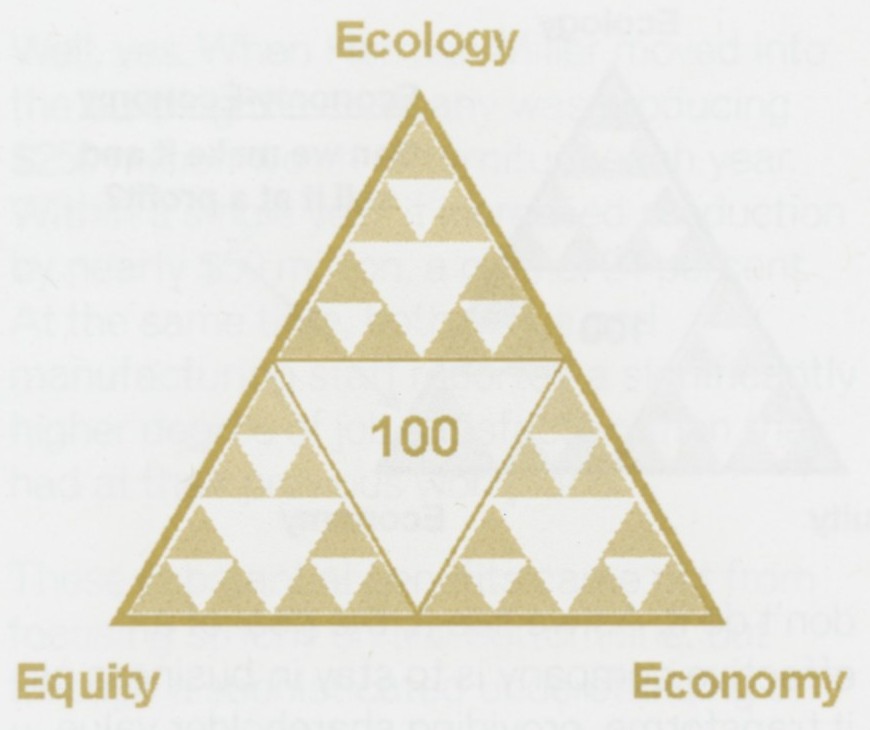
The fractal triangle, first of all, reminds us that every product, whether or not it is designed with environmental health in mind, is produced and used in an interconnected world. This is the fundamental insight of ecology and the reason why the famous triad of sustainable development is on the table in the first place.
Representing the ecology of human concerns, the fractal triangle shows how ecology, economy and equity anchor a spectrum of value, and how, at any level of scrutiny, each design decision has an impact on all three. As we design a product or building, we move around the fractal inquiring how a new design can generate value in each category. Again, the goal is not to balance competing perspectives but to optimize and maximize value in all areas of the triangle through intelligent design. Often, we discover our most fruitful insights where design decisions create a kind of friction in the zones where values overlap When applying the fractal triangle to our own projects, we begin asking questions in the extreme, lower-right corner, which represents the Economy/Economy sector. Here we are in the realm of pure capitalism and the questions we ask would certainly include, Can I make my product or provide my service at a profit? We tell our commercial clients that if the answer is no, 51 don't do it. As we see it, the goal of an effective company is to stay in business as it transforms, providing shareholder value as it discovers ways to generate positive social and environmental effects.
Moving to the Economy/Equity sector, we consider questions of profitability and fairness. Are the employees producing a promising product earning a living wage?
As we continue on to Equity/Economy, our focus shifts more towards fairness: we begin to see Economy through the lens of Equity. Here we might ask, Are men and women being paid the same for the same work? Are we finding new ways to honor everyone involved, regardless of race, sex, nationality or religion? In the extreme Equity corner, the questions are purely social: Will the new building improve the quality of life of all stakeholders?
In the Ecology corner of the Equity sector, the emphasis shifts again: Equity is still in the foreground, but Ecology has entered the picture. The questions arising at this intersection of values might explore the ways in which a product, such as the ecologically sound upholstery fabric, could enhance the health of employees and customers. Continuing to Ecology/Equity, we consider questions of safety or fairness in relation to the entire ecosystem: Will our product contribute to the health of the watershed?
In the pure Ecology sector: Are we obeying nature’s laws? Creating habitat? In this realm we try to imagine how humans can be “tools for nature.” Shifting to Ecology/Economy, commerce reenters the picture: Is our ecological strategy economically viable? Will it enable us to use resources effectively? Finally, we come to Economy/Ecology, where we encounter many questions that relate to the triple bottom line. Here the inquiry tends to focus on efficiency: Will our production process use resources efficiently? Will it reduce waste?
Each of these questions presents an opportunity for creating value. Considered together, they signal the possibility of each design decision to create multiple positive outcomes throughout the entire spectrum of concerns.
Multiple Positives
Herman Miller, the furniture manufacturer, was looking to create multiple positives when it commissioned the design of a 295,000 square foot factory and office near its headquarters in western Michigan. The company's goals for the new plant were to foster a spirit of collaboration between office and factory workers, and create a workplace with a restorative impact on the local environment. Working with a design team that paid close attention to local conditions, Herman Miller built a plant that serves the needs of all its factory workers and administrative employees by celebrating an array of natural and cultural delights.
The low-lying, curved building follows the natural contours of the Michigan grassland. Stormwater spilling off the building moves off the site through an extended series of wetlands that purify the water while providing habitat for hundreds of species of birds, plants and insects. Plantings of native grasses and trees provided additional habitat for local creatures and further enhance the beauty of the site. Inside the building, offices face the manufacturing plant across a sun-lit, urbane promenade where workers meet and lunch and drink coffee among whimsical sculptures and thriving plants. The entire building (the gyms, the bathrooms, the factory floor) is so pleasantly bright and airy, it is now known as “the GreenHouse.”
Does this enhance the well-being of workers? Create productivity and wealth?
Well, yes. When Herman Miller moved into the building the company was producing $250 million worth of furniture each year. Within a single year it increased production by nearly $50 million, a gain of 24 percent. At the same time, both office and manufacturing staff reported a significantly higher degree of job satisfaction than they had at their previous workplace.
These substantial benefits came not from focusing strictly on the bottom line, but through a sophisticated understanding of the synergy of economic, social and ecological concerns. The customized design of the factory, which suited Herman Miller's administrative and manufacturing needs; an innovative management strategy designed to enhance relationships with customers; the environmental quality of the building; and its harmonious relationship to its surroundings together created a better outcome than could have been realized if Herman Miller had narrowly defined its goals. As a result, the company is now doing business in a productive, environmentally sound, delightful workplace.
While it's impossible to measure the influence of delight, it's easy to imagine the pleasure of working in a place where you can always see the beauty of the surrounding landscape, where copious fresh air and light actually blur the boundary between indoors and out. Workers in such a place feel as if they have spent the entire day outdoors. They see the comings and goings of birds and the passing of the seasons. They come to know the place where they live, at work!
Such pleasures have an enormous impact on the spirit. After Herman Miller moved into the new plant, sixteen young employees left for jobs with higher wages. But they soon returned. When the president of the company asked, “Why are you back?" they said, “We want our jobs back because we had never worked in another factory before. We couldn't work in the dark.”
One of the icons of industry, The Ford Motor Company, is realizing multiple positives as it carries out one of the most sweeping acts of industrial restoration ever. Led by Henry Ford's great-grandson, William Clay Ford, Jr., the company has embarked on a 20-year, $2 billion restoration of its gigantic Rouge River plant in Dearborn, Michigan. Built between 1917 and 1925, the manufacturing complex remains one of the world’s largest. At its peak it employed 100,000 workers and churned out millions of cars (boats and airplane engines, too). It was the pride of Ford and the envy of industrialists from Tokyo to Berlin.
Yet by the beginning of the 21st century, the Rouge River plant was a brownfield, a sprawling wasteland of dark and dilapidated buildings, leaky pipes and old equipment. The land was contaminated, bare of all but the most persistent vegetation, and the river was badly polluted. Rather than walk away from a worn-out industrial landscape and a community that had supported it for nearly a century, Ford chose to transform the Rouge River site into a healthy, productive, life-supporting place. Indeed, Ford's leaders are now asking a revolutionary question: “When will we be able to let our own children play in the soils and waters of the Rouge?”
That critical question leads to a wide spectrum of inquiry. What specific innovations will make the site a place that invites the return of native species? How can the presence of the factory be beneficial to the Rouge River? On the grounds of the site what is the optimum depth of topsoil, number of worms per cubic foot and insect and bird diversity? What are the optimum aquatic populations of the river? How do we design a manufacturing facility that is a prosperous, supportive work environment?
These may sound like surprising questions for a car company to ask, but Ford is asking them, and answering them, too. In 2003, Ford unveiled a new automotive assembly plant featuring skylights for daylighting the factory floor and a roof covered with growing plants. The 450,000-square-foot “living roof” provides habitat for birds, insects and microorganisms. In concert with a series of wetlands and swales, the roof also controls and filters stormwater run-off. With these natural, built-in measures replacing the expensive technical controls called for by new regulations, Ford realized $10 million in first cost savings on stormwater remediation alone. Just as with Herman Miller's GreenHouse, these savings could not have been realized through a traditional approach to facility design.
As William Clay Ford, Jr. says, “This is not environmental philanthropy; it is sound business...” And he's right, of course. Businesses that fail to bring ecological and social concerns to commerce put shareholder value in danger and are not contributing to the larger prosperity.
Conclusion
These examples begin to suggest some of the ways in which considering the principles of the fractal triangle can create business opportunities. Applied throughout the design process, they introduce a new standard of quality, adding ecological intelligence, social justice, and the celebration of creativity to the typical design criteria of cost, performance, and aesthetics.
There is still a long way to go. Architecture has just begun, really, to design new ecologically intelligent materials that flow in cradle to cradle cycles and contribute to the health of those who manufacture them as well as the building occupants. Ultimately, it will be the delight buildings inspire, the way they enhance our feeling for life, that will move ecologically intelligent design from the agenda of a few to the demand of many. Imagine buildings so delightful, so expressive of the world’s diverse interactions between nature and human culture, so comfortably affordable for so many, so able to inspire wonder in the living world, that the demand for them is driven by pleasure from the bottom up.