
Published in Solar Today, November/December 2004
A Declaration of Interdependence: Jefferson, Design and the Future of Solar Architecture
By William McDonough.
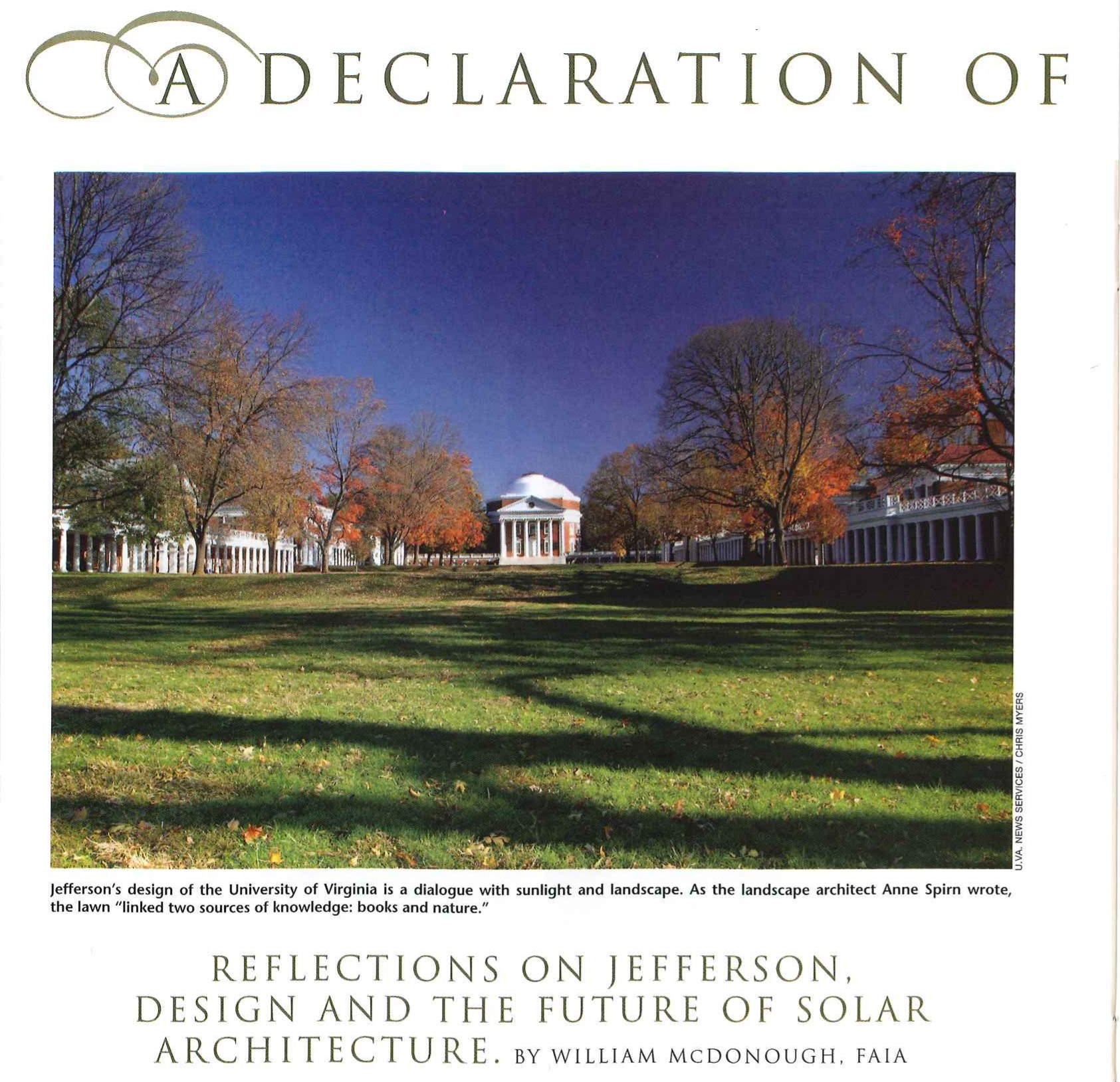
When I served as the dean of the school of architecture at the University of Virginia I had the privilege of living in a house designed by Thomas Jefferson. Had I simply inhabited a singular Jeffersonian home, the experience would have been a source of profound and inspiring pleasure, but the house was only one part of a magnificent whole. Known as Pavilion IX, one of ten classical pavilions on the gorgeous University of Virginia lawn linked by colonnaded walkways to Jefferson’s domed Rotunda, the house is part of a grand composition, a unified “academical village” widely considered the greatest piece of architecture in America. And so to live in Pavilion IX was to be immersed daily in an exquisite essay in architecture and to feel a deep sense of appreciation for the legacy of design.
Indeed, I think Jefferson saw himself, first and foremost, as a designer. Among all the achievements of his long and productive life he wanted to be remembered for three things. They are inscribed on a stone obelisk over his grave at Monticello. “Here was buried Thomas Jefferson,” the inscription reads, “Author of the Declaration of Independence, Of the Statute of Virginia for Religious Freedom, And Father of the University of Virginia.” This from a man whose distinguished career included eight years as President of the United States. For Jefferson, his activities were not as important as the things he designed, which suggests a mind keenly attuned to the ways in which the thoughtful, poetic ordering of things could create a vital legacy.
And it is a vital legacy. In the things Jefferson made, from Monticello to the Statute of Virginia for Religious Freedom, which matured into the Bill of Rights, we can see a design sensibility that speaks to us today. We can see a sense of balanced composition subtle enough to include tradition and invention, science and aesthetics, nature and culture, freedom and responsibility. We can see a breadth of interest that took in politics, economics, natural history, and an agrarian’s keen attention to the living earth, and rendered them visible in actions that changed the world. We see an architect, embracing both the practical and the poetic, who designed a beautiful, sophisticated solar home. We see a man who, if he were with us today, would likely be calling for “Declarations of Interdependence” that recognize that our ability to pursue wealth, health, and happiness is dependent on other forms of life and that the rights of one species are linked to the rights of others.
That’s the deep, broad context in which we need to think about solar architecture, for an effective, sustaining solar architecture is a lot more subtle and sophisticated than an array of technology on the roof. In fact, as the social and environmental costs of burning fossil fuels become clearer by the day, to rely simply on technology to address the impact of the built environment, designing buildings as machines for collecting the sun’s energy, for example, is to miss a magnificent opportunity to capture the public imagination with designs that render the delightful, poetic, deeply cultural prospects of a solar-powered world.
The End of Oil Hegemony
For more than thirty years, architects, engineers, and entrepreneurs interested in bringing forth a solar-powered world have had to fight an uphill battle. The problem has never been that the world is not ready for solar energy. From the viewpoints of economics, sustainability, and international relations, it has long been understood that an economy fueled by a single, non-renewable resource is unstable, prone to panic, and ultimately destructive. Factor in acid deposition and climate change and it becomes ever more obvious that a petroleum-powered industrial system is rife with design problems the average citizen would love to see fixed.
But the energy playing field has never been level. In the mid-1970s, when the United States had its first oil shock, Saudi Arabia’s OPEC minister, Sheik Yamani, outlined the cartel’s strategy to financially short-circuit all major investment programs in energy alternatives. Whenever alternative technologies were ready to compete with oil, OPEC instituted dramatic price manipulations to undercut investor confidence in the new, and suddenly much more expensive, energy source. This was possible because Saudi Arabian crude oil can be extracted at a marginal cost of $2 a barrel: it is lightweight and travels quickly to the surface and is therefore both easy to harvest at a moment’s notice and to profitably sell at exceedingly low prices.
We must also remember, however, that even Sheik Yamani understood that the oil era would come to an end. When asked to forecast the future of oil he replied, “All I can tell you is the Stone Age didn’t end because we ran out of stones.” Just so, the age of fossil fuels can end, peacefully, with prosperity intact, long before we run out of oil.
The first step is to recognize a truth long-obscured by modern industrial culture: the sun represents a free form of energy income that the planet receives on a daily basis. And now it can be tapped cost-effectively. In spite of more than $20 billion in annual U.S. government subsidies to the oil and nuclear power industries, renewable energy entrepreneurs have begun to make the various forms of solar power a viable alternative. Wind power, a renewable energy driven by solar flux, is growing at 30 percent a year; in the Midwest the cost of a wind-generated kilowatt hour is now effectively cheaper than a kilowatt hour generated by natural gas. Passive solar has been cost-effective forever, while solar derived hot water now has paybacks that can be measured in a few years; it is increasingly popular in Israel and Ireland and is becoming ubiquitous in China. The active harvest of the sun’s energy by photovoltaics, meanwhile, is now seen as being cost-effective in most places in a decade. Within any intelligent planning scenario, the solar age is upon us.
From the Farmhouse to the Cathedral: Traditions in Solar Architecture
Despite the good news, many architects continue to practice as if the sun didn’t exist, and by some this is perceived as a great, stylistic leap forward. At Yale in 1975, while I was designing what would be the first actively and passively-heated solar house in Ireland, a world-renowned architect famous for his sleek, white, modernist buildings looked over my shoulder during a desk-side critique and dismissed the project. “Solar energy,” he said, “has nothing to do with architecture.”
That is an astonishing statement in light of the fact that the history of architecture, from the Roman Pantheon to Monticello to the vernacular tradition, can be read as the story of the development of beautiful, effective ways to design buildings in harmony with the movement of the sun. To see this in the American vernacular, all one needs to do is observe the typical nineteenth-century farmhouse with its deciduous tree on the southwest for shade, its conifers on the northwest for a windbreak, and its scarce, valuable windows facing south for light. These elegant, practical solutions, which represent an ongoing dialogue with the sun and the surrounding natural world, were once considered so obvious they were known as “farmer dumb.” When we look at a typical American subdivision today and see rubber stamped buildings on a cul de sac facing every which way, we have to ask, “What kind of dumb is this?”
The architects and builders of ancient Greece would have answered, “Quite dumb.” In places like Mykonos, a dialogue with light and shadow was a fundamental element of the vernacular of the Greek village. Each cottage was built with thick walls that transferred the heat of the winter sun or the coolness of the summer night into the interior, while deep, whitewashed window reveals reflected light coolly and deeply into the space. One finds similar responses to the sun all over the world. The vernacular tradition has always understood light and mass. It has always created a native architectural language, a response to place fundamental to the practice of architecture.
Yet it was precisely the vernacular that my teacher at Yale was dismissing. He might have said, as the architecture critic Nicholas Pevsner famously did, that “a bicycle shed is a building, a cathedral is architecture.” Perhaps. But the cathedral is no less in dialogue with the sun than the Greek cottage. Consider Vitruvius. The Roman master’s encyclopedic treatise on architecture, hugely influential in his time and in the Renaissance, contained whole chapters on the profound significance of the sun’s movement in relation to the location of rooms, the size of apertures, thermal mass, and so on. A building insensitive to the sun would have left Vitruvius aghast, as it would have the other great designers of the celebrated temples of Rome.
Vitruvius’ writings are deeper than fashion. Fourteen hundred years after his death they influenced Palladio, another Roman master, and he in turn had a profound influence on Thomas Jefferson. In fact, the self-taught Jefferson studied Roman architecture assiduously. He was very familiar with Vitruvius and Palladio, and drew inspiration for his buildings from the classic “cathedrals” of Rome, including the Pantheon, which is the model for the Rotunda at the University of Virginia.
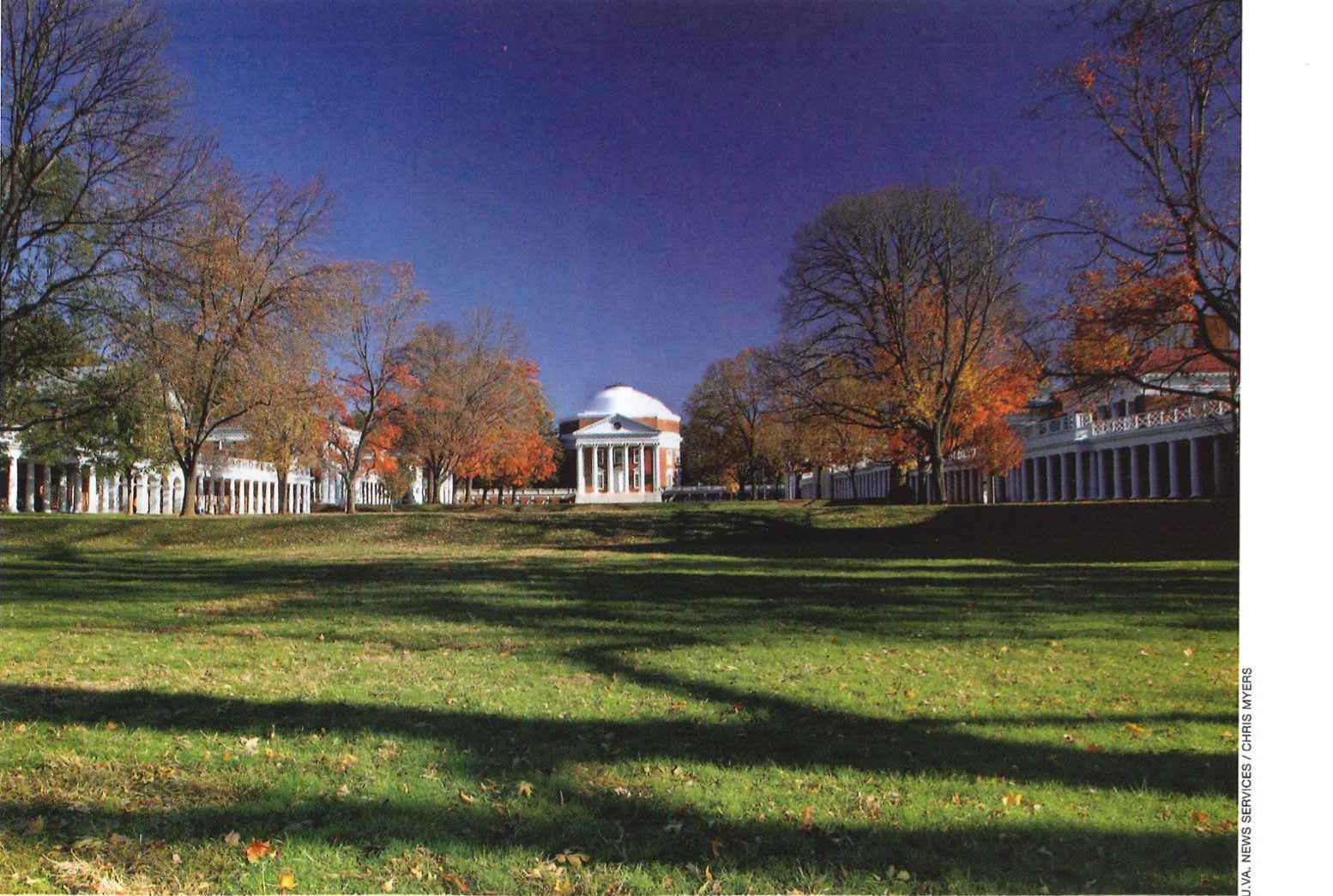
The University of Virginia itself is a dialogue with sunlight and landscape. The terraced lawn, bordered on two sides by the ten pavilions and on one by the Rotunda, was designed by Jefferson to remain open to the south. This allowed the lawn and the colonnaded walkways to receive sun in the morning and evening with delightful contrasts and shadow play. In addition, the open south lawn, which offered a magnificent view of the nearby Blue Ridge, also represented the university’s openness to the natural world. As the landscape architect Anne Spirn wrote, the lawn “linked two sources of knowledge: books and nature.” Clearly, this dialogue with nature did not make a bicycle shed of Jefferson’s university.
On the contrary, the design’s sensitivity to the natural world is an integral part of a great essay in ideas and architecture that creates a beautiful living language from the forms of the past. In the composition of a variety of classical motifs, for example, the university signifies the balance between rational thought and aesthetics, practical order and expressive individuality that Jefferson believed are the cornerstones of great democracies and great architecture. The domed Rotunda and its ovular rooms, which housed the library, suggest a Platonic search for pure form and poetic space, while the colonnades and porticos of the ten great pavilions, home to teachers and classrooms and the logical progression of learning, can be seen as signifying Aristotelian rationality. In effect, Jefferson’s design brought together the ancient Academy, which revered beauty as the highest order of intellect, and the Lyceum, which honored rational thought, and made them a university, a new social institution created by design.
Monticello: The Sophisticated Solar House
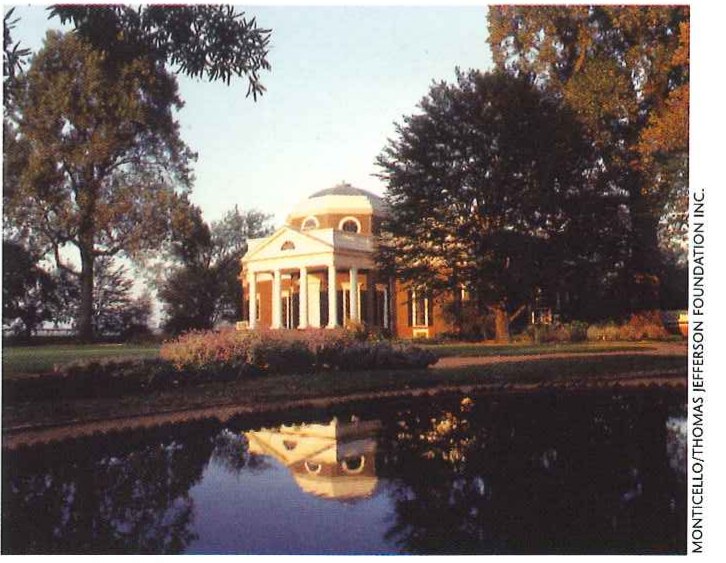
Before designing the University of Virginia, Jefferson started performing his architectural experiments on himself, at Monticello. There, too, he combined logic, in the form of practical, engineered solutions, with inspired poetics, but always with a deep understanding that he was building a house in the sun, always aware of orientation and light. Like the agrarians he celebrated, he paid attention to the obvious. In a letter to his daughter, we hear him bemoaning the fact that the sycamores he had planted on the south side of Monticello were not yet tall enough to adequately shade the house. And visiting Monticello, one sees that he placed his ice house on the shady north side of the building complex, attended to thermal mass in Monticello’s structure, and chose the placement and shading of windows in relation to the movement of the sun.
Less obvious were subtle interior design decisions. Though this is my guess and is unsubstantiated by research, it appears that Jefferson may have created a duct-like alcove for his famous bed between his shaded study on the southwest and his two-story dressing room. The chimney effect between the rooms would have alone created refreshing air movement, and if the rooms had been flushed by air from the earth-cooled cellar, which is quite possible given the design of the house, Jefferson might well have spent many nights during Virginia’s hot, humid summers comfortably reading, thinking, and sleeping in his bed.
The scientific instruments Jefferson used at Monticello also suggest an acute understanding of landscape, the laws of nature, and solar flows. These range from his solar microscope to his orrery, a model of the solar system that shows the placement and movement of planets, to his theodolite, a surveyor’s instrument with which Jefferson, according to Monticello’s Senior Research Historian Lucia Stanton,“fixed the true meridian of Monticello, calculated the position of features of the Monticello landscape and surrounding mountains, and may have used in his observation of the solar eclipse in June 1778.”
Jefferson’s love of scientific thinking, however, didn’t keep him from putting Monticello on top of a hill, which in many ways was an immensely illogical decision. Most dwellings of any kind during the seventeenth century were built in valleys and along rivers to take advantage of natural water flows. But at Monticello, water had to be brought to the top of the hill. Though Jefferson was a practical man, he would not be ruled by the practical. He was creating poetry when he built on the hilltop. He was seeking not an embodiment of state-of-the-art engineering but a beautiful, idiosyncratic home with a view of the world, a place to consider, literally, imaginatively, and intellectually, the entirety of the natural and human prospect.
“It was Jefferson’s genius” writes architecture critic Paul Goldberger, “that, for all his reflection, he seemed forever to focus outward, to think in social terms and to make certain his architecture expressed this. Monticello looks out, not in – its classicism seems to yearn more for a democratic future than for a classical past, and at every moment it reaches out to the landscape Jefferson loved.”
The Future of Solar Architecture
Wouldn’t it be marvelous if the new solar architecture reached out to the landscape toward a prosperous, democratic future? Wouldn’t it be magnificent if we forever left behind the simplistic, 1970s engineering approach to solar architecture, which in many cases created uncomfortable, unsightly machines for gathering the energy of the sun? Instead, why not enter a creative dialogue with the sun, as Vitruvius and Palladio and Jefferson did, that generates a living architectural language for our time, a language that celebrates light and landscape, people and place, community and creativity while also rediscovering the practical, effective genius of “farmer dumb.”
We don’t need to simply imagine this new design sensibility. It is evident in the work of prominent architects worldwide. Consider Lord Norman Foster. In his designs for the Reichstag and the Commerzbank Tower in Germany, and for London’s new city hall, one sees a formally rich design sensibility combined with an innovative approach to solar architecture. Words like “gorgeous” and “splendid” and “serene” are used to describe these buildings. As the New York Times reported, Foster is “mining the expressive potential of low energy construction” to create buildings “as elegant as any in the world.”
William McDonough + Partners is also engaged in designing buildings that bridge the gap between the vernacular and the cathedral. At Oberlin College, we designed the Adam Joseph Lewis Center for Environmental Studies to create rich, interactive dialogues with nature within an inspiring, poetic space. The result is a solar-powered cultural space designed to generate more energy than it consumes, a building and a landscape so in tune with the biosphere their impact on their place is regenerative, like a native tree.
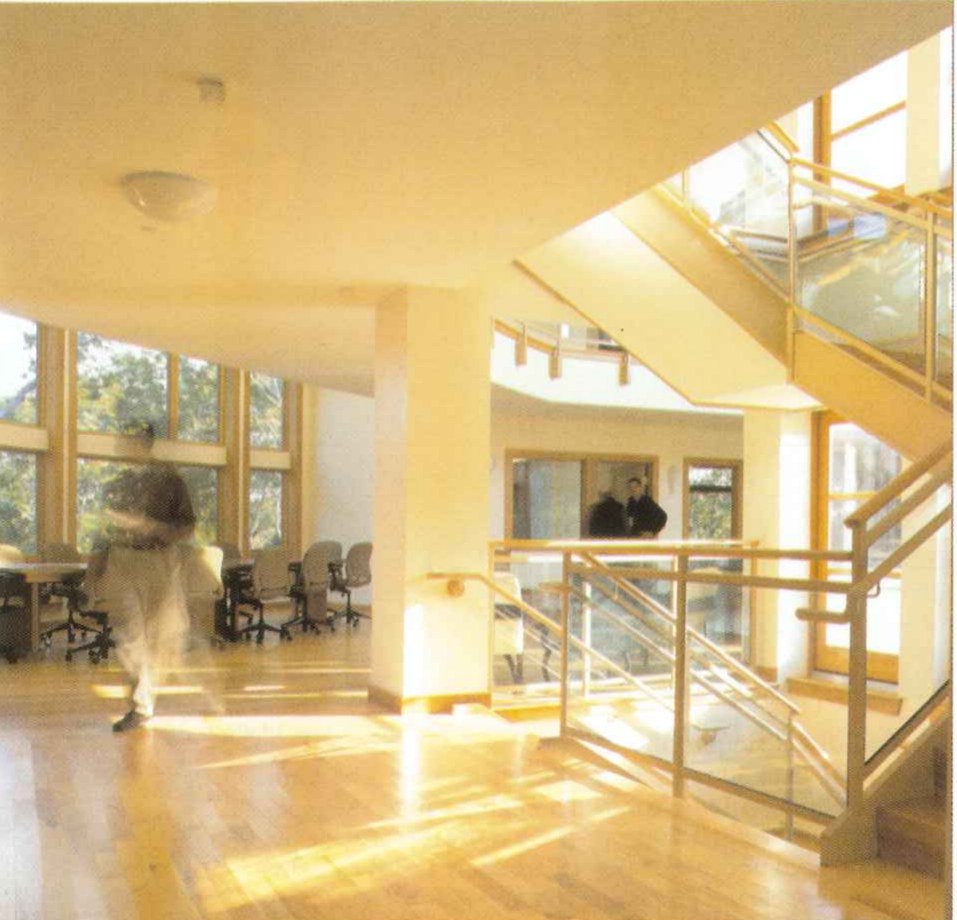
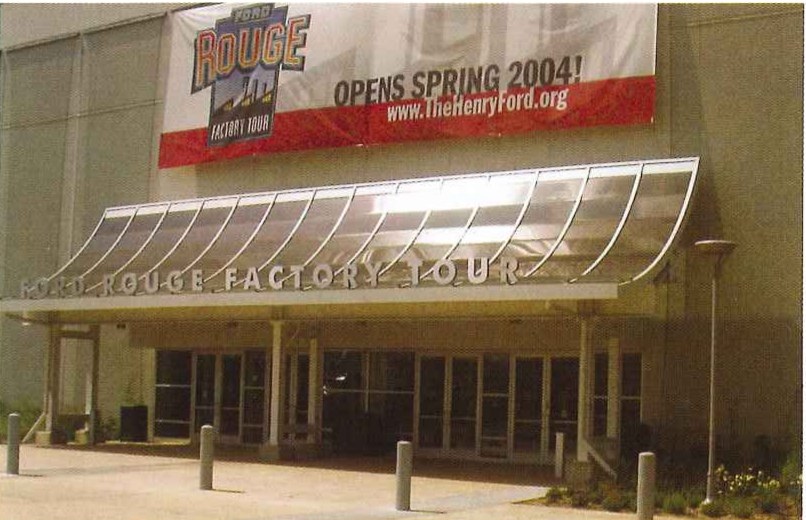
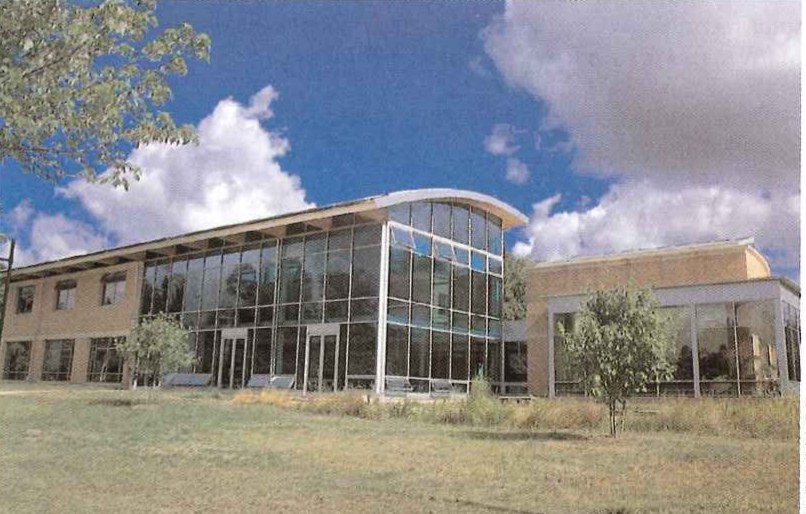
Thomas Jefferson, we can imagine, would have understood the intentions of these buildings. He might have appreciated them for their effectiveness or for embodying inspiring ideas in the public realm. He might have noted their poetry and practicality. And perhaps he would have seen them as declarations of interdependence, as embodiments of an architecture in dialogue with the sun and with other life, an architecture that reaches out to the landscape and beyond to celebrate the richness of the human prospect.