
Green@Work, May/June 2000
The Hopeful Inventors
By Katie Sosnowchik, with William McDonough & Michael Braungart.
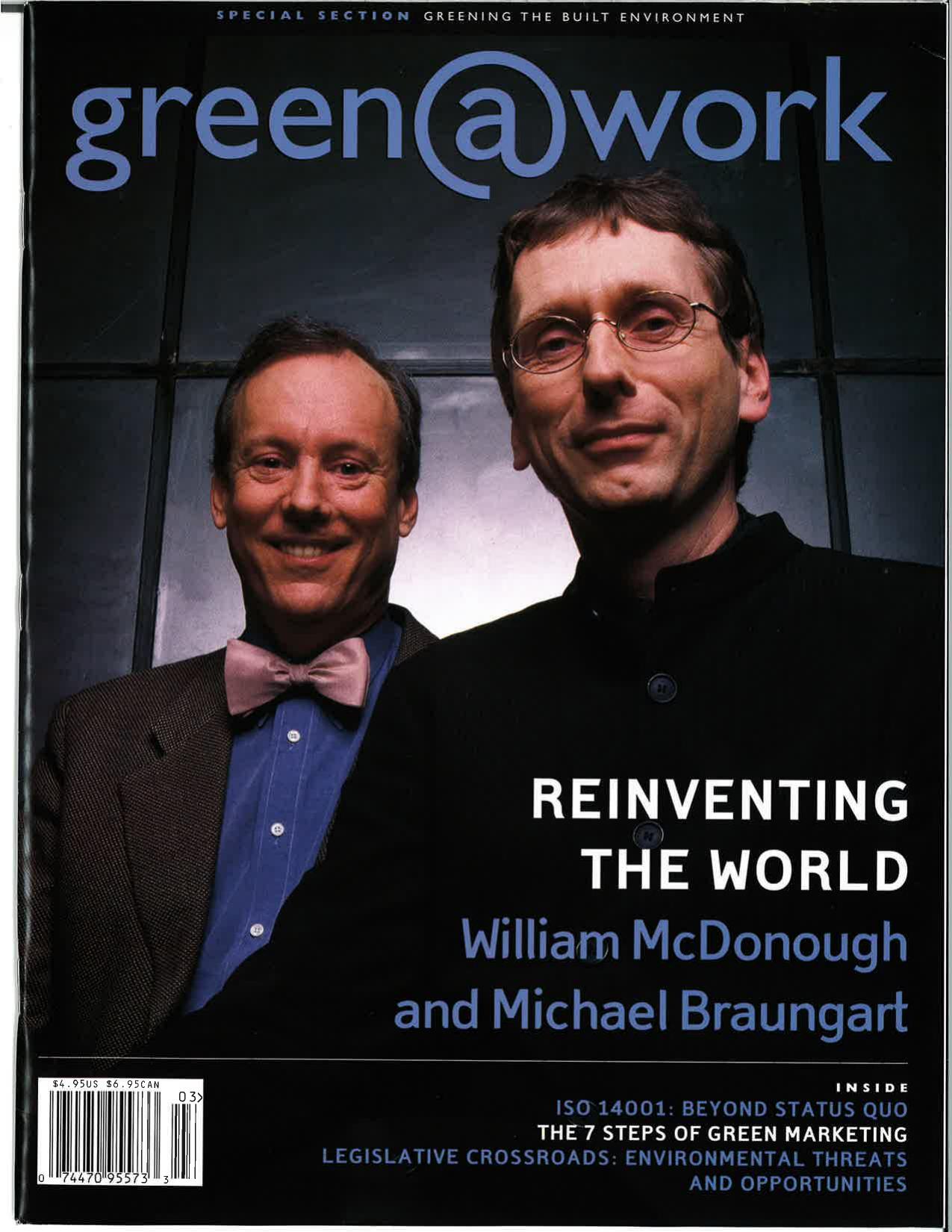
What does an American architect with an Ivy League background have in common with a German chemist who | was, at one time, a protestor for Greenpeace? The two share an unrelenting hope and contagious, indefatigable spirit for the future. They believe in a tomorrow where every single thing, from tennis shoes to corporate headquarters, can be re-invented with nature as its model. And one by one, the charismatic, bow-tied former dean of architecture and the quietly eloquent professor of materials flow management are persuading corporate America to think the same way they do.
They met in 1991 at a rooftop reception in New York City. William A. McDonough, FAIA, had a few years earlier completed the headquarters design for the Environmental Defense Fund, one of the very first “sustainable” design and architecture projects to register on the environmental radar screen, and had since earned a reputation for intelligent ecological design based on that and subsequent projects. The party was held to celebrate the opening of the first U.S. office of the Environmental Protection Encouragement Agency (EPEA), a Hamburg, Germany-based scientific consultancy founded by Dr. Michael Braungart that develops ecologically optimized product concepts for its customers. Because of McDonough’s pioneering work in the area of sustainable design, he was one of a few private individuals to receive an invitation for the evening, an invitation that, because it was printed on a biodegradable diaper, proved too intriguing to resist.
When recounting that evening now, both can recite a detailed account of their single-minded conversation about toxicity and design even though nine years and, most likely, thousands of ideas have since passed between them. Their first joint venture was the creation of The Hannover Principles: Design for Sustainability, written for the organizers of the 2000 World’s Fair in Hannover, Germany. Today, they share a common business enterprise, McDonough Braungart Design Chemistry, which helps companies implement “eco-effective” design and commerce strategies. They also pursue their own individual practices. And they are currently working on a new book, Cradle to Cradle, to be released early next year.
The work McDonough and Braungart do at MBDC is diverse and far-reaching. As more companies recognize the necessity of incorporating environmental awareness into their thought processes and environmental actions into their business practices, they are turning to consultants like McDonough and Braungart to affect the changes required. In fact, the names McDonough and Braungart are, well, household ones to the CEOs of companies like Ford Motor Co., Herman Miller, Johnson International, Dow Chemical, Steelcase, Unilever, Nike and The Gap.
What attracts these executives to McDonough and Braungart’s visionary ideology is the fact that it is grounded in sound business practices. It is possible to do well by doing s S good, the two insist, and prove it with a multifaceted analysis that uses three highly interdependent categories to assess existing products and approach their redesign: ecology, social equity and economics.
It also is not uncommon to hear corporate leaders enthusiastically borrow some of McDonough and Braungart’s more familiar terms and statements: “How can we love all of the children, of all species, for all times?” “Design is the first signal of human intention.” “For a strategy of change, we need a strategy of hope.” “Waste equals food.”
The list of MBDC clients is growing. As a result, it has recently metamorphosed into a more structured organization, complete with business and marketing managers, editors and administrative support personnel, in order to free up McDonough’s and Braungart’s time to do what they do best: dream the big ideas that will help them reinvent the world.
What gets you excited about going to work?
McDonough: I can’t imagine anything more exciting than the work we do together. When I wake up in the morning, I think about my family; as soon as I shift gears and start moving toward the work world, all I have to do is think about Michael and his mind, the kinds of things he’s talked about the last time he and I had a conversation, and I'm completely recharged for any sense of where the work might drag me down. It’s exciting because we’re inventing every time we talk to each other. Our conversations are kind of odd because they’ll go wherever they need to go; we’ll be creating new things as we speak. And so most of the work day is about putting these things into practice. When Michael and I talk, it’s not necessarily about day-to-day business issues. We have terrific people around us who worry about those things quite a bit. Our time together is optimized by doing inventions. So we’re basically talking about new products and new ideas all the time. That’s where we live.
Braungart: I come from the chemistry side and Bill is able to put things in the bigger picture, to combine ideas with cultural and aesthetic perspectives.
Remember, nothing is designed for indoor use. It's only designed to be cheap and to work for a certain period of time. We have fun because we can take anything and reinvent it from a paradigm of waste equals food.
We have a positive, creative relationship. What helps is we can put things on the table without worrying that it needs to be perfect. It’s a new chance to forget the past 25 years of gloom and doom. We gain so much information from each other, we believe we can reinvent everything around us, because right now everything is simply not designed for human purposes. It’s designed only for financial short-term benefits and, in a lot of cases, not even for that because it creates liability problems.
Isn’t this kind of relationship rare?
McDonough: Yes, it’s very rare. And it’s fun. Michael was once asked by someone, “Why won’t you work with us? Why do you only work with Bill?” And I've been asked that question, too. Why do I only work with Michael? We both have the same answer, which is when we talk to each other, the other person responds to an idea with another idea. It’s always interactive, it’s always going somewhere.
Braungart: We don’t propose, for example, a guilt thing. We don’t want to simply reduce, avoid or minimize. As Bill says, if you start off with 100 percent bad, how attractive is it to be 90 percent bad? Instead we ask, how good are we compared to what we want to be? And so it’s a positive agenda and it creates a lot of synergy. Instead of having a car that gets 10 miles per gallon, and then coming up with a car that gets 12 miles per gallon, how attractive is that? Instead, ask how much fun it is per gallon. And so we create a challenge for industries to come up with a totally different type of quality. Take a television. Back in 1986, I started asking, “Do you really want to own 4,360 different chemicals? Or do you want to watch TV?” And people said, “Oh, that’s communism.”
But today, it’s no longer the case. Ownership is no longer a religion. And so people now ask, “What is important to us in our lives?” And then they understand that owning hazardous waste is not what they’re interested in. And so we come back to the idea of services and go to companies like Dow Chemical, and we propose to them the concept of renting solvents. When we created the idea in ‘89, nobody thought it would work. And now paradigms have changed and we see companies gaining a big competitive advantage with the concept.
Has what you're doing changed from a few years ago?
McDonough: Not really. Michael and I first collaborated intensely on the Hannover Principles for Expo 2000, the World’s Fair. Since then we’ve shared our ideas with a lot of different people. And our ideas are now becoming very public, which is the best form of peer review. Ideas like the product of service concept, the eco-leasing concept and the concepts of biological and technical nutrients. So we’re seeing this transformation become accepted. What’s exciting is that we’re expanding on these thoughts and we’re now at the point where TIME magazine even says we’ve developed a unified theory that, in a demonstrable and practical way, is changing the design of the world.
What do you think is helping to turn companies around?
McDonough: What our clients tell us they’re excited about is the fact that we’re actually doing things, we’re not just talking about it. We’ve made products, the product we did for DesignTex was a huge success in the marketplace and still is. It’s inspired a lot of people here and in Europe. It’s been pointed to as the thing that sets the standard for others to live up to. There’s also Michael’s work, especially with the chemical industry, which is very well respected. And there’s also the buildings created by all the partners at William McDonough + Partners. The buildings are the most productive buildings in America according to Business Week. We’re all working together to manifest these things physically. We’re actually taking ideas and putting them into practice. I think that’s what’s getting everybody so excited.
Will the new generation of leadership emerging in corporate America impact change?
McDonough: The fact that we now have products that we can point to means that younger executives, who have seen these things and have been waiting for the positive examples because they knew in their hearts and their minds that this must be possible some day, they can now stand up and say, “I'm going to go in that direction.” Because a company, for example, like Herman Miller, which went out on a limb to do something, is finding that it’s increasing its performance by over 20 percent. They did it because it was the right thing to do. But now the data is starting to come in. And the data is compelling. When a business starts to perform at a 20 percent increase and all they did was move to a new kind of facility, you have to ask, “Why is this happening?” And so young executives are in a very strong position to say, “That’s what I want. Go find it, go get it, let’s do it.”
Braungart: On another side, the chemical industry, which thought we would be their biggest enemy 10 years ago, now understands that we can help them with their brand chemicals.
McDonough: Taking a positive approach honors the need to develop better products in order to put them in closed technical cycles so that all people can enjoy quality of life issues as they relate to material and energy flows. If we're going to be able to share materials in a way that allows every child that’s born to have some hope of engaging in the most propitious way, in both natural and industrial systems, then we’re going to have to have synthetic products. It’s not like we're all going to wear organic cotton and Birkenstocks, because the world would dry up and we’d run out of cork. Wouldn’t it be wonderful to be able to celebrate plastic, for example, instead of just bemoan its existence?
So, the idea is that you look at things with a fresh mind. How sophisticated is human design? Let’s face it, we humans just figured out how to put wheels on our luggage. With advanced polymer technology there’s absolutely no reason that flat white surfaces on which we wish to move information couldn’t be delightfully conceived as totally recyclable, totally safe, that the inks could be totally recyclable, totally safe. Wouldn’t it be wonderful if those things were not conceived with ancient technologies that have lost all their vitality in a modern context? We need to rethink the fact that we are taking ancient forests and using them to move information around. It’s absolutely idiotic at this point in human history. So from a synthetic perspective, we're ready to redesign almost everything.
And so it’s not about eco-efficiency or being less bad or even coming up with the flow of conventionally conceived paper as being a service, for example. It’s actually about reinventing and reimagining the concept of paper and just about everything from scratch in a delightful way. It’s really a thrilling prospect and it’s going to allow companies to redefine the system, because in the end, what business is about, as ecology is, is the idea that you identify the most prosperous niche and then inhabit it. And so, what we’re seeing are new niches. It’s all about high speed change and then survival of the fittingest, not necessarily the fittest.
You’ve reached a point now where companies are seeking you out. Is that gratifying?
McDonough: Yes, but the other thing that’s gratifying, part of what’s exciting for us now, is that people are saying that we’re helping them understand what this is about. For example, references to the fractal triangle are constant. We get calls from people saying, “I finally understood it once I saw that.” Once people start to see how these things relate to each other and the self-similarity, and the more intensely you deal with any one part of it, the better the whole gets. They can see the relationships. So I think the tools we’ve been able to develop have been effective to communicate this concept.
Braungart: Sometimes we do have great debates and discussions. For example, with the car industry. The chemical industry understood after Bhopal that they cannot continue like they do. But the big crisis for the car industry is still ahead. The question is, can companies transform into selling transportation instead of selling cars, before a crisis or do they need that crisis?
There’s also the connection with environmental groups. For example, in Europe we still work with Greenpeace to make the change, and we’ve learned that it’s good to work with all good-willing people together, wherever they are. We're not interested to be right or to dominate others. We have to bring something to the table where we have a strong qualification, but it doesn’t make sense not to work with other people because then you don’t come up with products and new types of services.
We see a lot of cases, family businesses, where family members still play a role, they are far more sensitive to these things than simply thinking about pure profit and shareholder value because, in the longer term, they wonder about the legacy they will leave behind. Do they really want to be in charge and responsible for all this destruction? Family businesses play a real key role and have a very important function.
McDonough: It’s interesting to note that they’re perfectly able to say that they wish to create value while making the transformation. So it’s not a question of doing bad business, it’s a question of doing magnificent business. It’s not about feeling guilty or bad, it’s about change. It’s about high speed change. It’s about profitable change, for both short-term and long-term agendas.
When you are invited by CEOs to come into their companies, are you being accepted by their staff?
Braungart: It depends on the management structure. If the management itself invites people and not forces them, then they get the smartest and most talented young people together to make a change. We don’t claim to these people that they are bad and we are good. We develop systems using natural principles, but they are synthetic systems and they’re not built on avoidance minimization and guilt things, because nature doesn’t know guilt. Nature is wasting energy and raw materials, but the right energy sources and the right materials, putting them back into cycles. We do the same for industrial metabolism. It allows us not to blame people. They have to bring a lot of things to the table. We do not know how to produce a car, basically, but we know what can be a new concept for a car to bring that car back into a technical cycle.
McDonough: What happens when we work with companies is, essentially, we just open up the opportunity. If we're dealing with someone who is at the end of their career and doesn’t want to start dealing with these new ideas, we don’t ask that person to change their career at the last moment and start to adopt these principles or try to put them into play. It wouldn’t be fair to them because it’s not something they necessarily want to do.
What we offer them is the opportunity to open these issues to their younger staff, who may or may not want to be engaged, that’s what I think Michael meant by opening up the opportunities to volunteers. There are plenty of young people dying to get involved in this. As soon as the company opens up the opportunity to them and asks who wants to work in this venue with these ideas, then they just allow those people to rise to the occasion. You see people who are about to design their own career, the next 20 years of their career, around these ideas. And then you see how exciting things can get.
Braungart: There are, too, a lot of older people who are far more interested in the personal, far more value oriented. Oriented toward children. And so, we get all the good-willing people together, wherever they come from.
What is it about the McDonough Braungart Design Protocol that makes it so attractive to companies?
Braungart: It’s more that the companies become a part of it. They understand that without capitalism there’s no economically reasonable product. Left wing people think that without social aspects there’s nothing there. And environmental people see only one component. So we don’t blame people, we take them from wherever they come from if they’re intent to change things. And make it attractive. If you look at the environmental and health considerations, you see that production itself gets cheaper. Some of the organizations in Europe that were originally against the protocol were the trade unions, because the workers would lose the extra money they got as subsidies to compensate for the damage of working with carcinogens.
McDonough: The real value of the fractal is that it honors every participant, no matter where they’re participating. So just because you’re an extremely socially interested person, it doesn’t mean that you need to feel guilty that you're not taking care of the environment or business right away. If another person is extremely involved in the economics of something, you honor their role, but at the same time they can’t ignore those other players. That’s the difference. The fractal has been really useful because it honors everybody as long as they understand they’re part of a larger picture. It's when they see themselves as being the center of the universe and that other people don’t matter, that we get into trouble. It’s critical that environmentally intelligent products be economical, and it’s up to the people who focus on economics to determine how to make it economical and we delight in their participation.
I think it’s so important, as Michael points out, to also engage all the other players. The fact is we work very closely with Greenpeace. We need to hear what Greenpeace is thinking. We need to know what they’re concerned about. We need to be able to address their concerns just as much as we address the concerns of business. And it’s going to take all of us. The sooner we get underway, and the more we communicate, the better. Because this idea that everybody has been focused on their own agenda means, as we put it, they’ve been sort of timefully mindless. They’re in a big hurry and they’re mindless of their effects in the world and on other people. If we look for a kind of timeless mindfulness, then we need to be mindful of everyone’s concerns. It’s very inclusionary, and there’s a great deal of drama in the pleasure of discovering the fact that we all are working for the same thing.
By offering the MBDC protocol on a non-exclusive industry basis, do you hope to accelerate the rate of change?
McDonough: Yes, it’s also one of the requests of some of our major clients. For example, Ford Motor Co. has asked that we work with all their suppliers and that there be no exclusives per se in the auto industry so that everyone has a chance to put these protocols into effect. We recognize that our protocol has become a kind of standard that people really like, because it gives them something to focus on. And there doesn’t seem to be another standard like it that has the same quality and characteristics. The fact that a company like Ford would request their suppliers to engage in this way is very exciting for us. And I think an appropriate thing, too.
Braungart: And the interesting thing is when we can bring materials back into cycles it can strengthen the competitiveness of an industry. We have learned, too, that we have far more to do than we have ability and still keep the quality of our work. So that’s a reason why we go back and do training, education and management support, we are helping companies learn, too, instead of doing the whole thing by ourselves.
Is MBDC where you want it to be today?
McDonough: Five years ago, both of us were working within universities. Michael as a professor of material science in Europe and I as a dean of architecture, because we felt it was important to communicate these ideas to students. I think we’re now fully engaged in the work.
Braungart: It was important that the things we were doing were scientifically based and that young people could learn about these things. But now we want to focus on doing things. Compared to the speed of destruction, though, we are far too slow and we are concerned about that. We either make the change now, in the next 10, 20, as late as 30 years, or there’s no opportunity, because then the earth destroys itself. At a certain point, if you add more and more carbon dioxide into the atmosphere, it doesn’t count what you do because the water vapor, which comes up in the atmosphere from heating up the climate, leads to an additional greenhouse effect. And then carbon dioxide cannot be stored any more in the same quantities in the ocean, because the vast majority is stored there. And the vegetation, which then is destroyed by thunderstorms, does not allow itself anymore of the carbon dioxide. So if we reduce …
Designing the Next Industrial Revolution
In October 1998, McDonough and Braungart authored an article for The Atlantic Monthly entitled, “The NEXT Industrial Revolution.” This seminal article challenged the popular concept of eco-efficiency, the dominant strategy of environmental change proposed by both industry and environmentalists. “Plainly put,” wrote the authors, “eco-efficiency aspires to make the old, destructive system less so. But its goals, however admirable, are fatally flawed. Reduction, reuse and recycling slow down the rates of contamination and depletion, but do not stop these processes.”
What McDonough and Braungart put forth was a radical new paradigm they coined eco-effectiveness, a concept that leads to human industry that is regenerative rather than depletive. “Nature, highly industrious, astonishingly productive and creative, even ‘wasteful’, is not efficient but effective,” they describe. Eco-effectiveness celebrates the abundance and fecundity of natural systems, and structures itself around goals that target 100 percent “sustaining” solutions. It involves the design of things that celebrate interdependence with other living systems. From an industrial design perspective, it means products that work within cradle-to-cradle lifecycles, rather than cradle-to-grave. To illustrate their point, McDonough and Braungart point to the cherry tree. It makes thousands of blossoms just so that another tree might germinate, take root and grow. Who would notice piles of cherry blossoms littering the ground and think, “How inefficient and wasteful?” The tree’s abundance is useful and safe. After falling to the ground, the blossoms return to the soil and become nutrients for the surrounding environment. Every last particle contributes in some way to the health of a thriving ecosystem. “It is time for designs that are creative, abundant, prosperous and intelligent from the start. The model for the Next Industrial Revolution may well be right in front of us the whole time: a tree.”
The McDonough Braungart Design Protocol
McDonough Braungart Design Chemistry was established in 1995 to realize its founders’ intention of jump-starting the “Next Industrial Revolution” through better design, or rather ecologically intelligent design, by incorporating broad scientific and ecological knowledge into existing design criteria. MBDC partners with companies on in-depth, multifaceted analysis and synthesis of products and processes to comply with a set of principles and criteria known as the McDonough Braungart Design Protocol™.
The protocol calls for a pre-eminent strategy for the future of industrial design. It is a unique and proprietary design tool that evaluates a product’s materials and processes to arrive at a point from which redesign for sustainability can take place. During the process of redesign, the protocol continuously reviews and tracks improvement of the product and its surrounding systems.
“There are two fundamental metabolisms in the world: one is biological, the natural world we inhabit, of which we’re physically a part. The other is what we call the technical metabolism, the metabolism of human industry. We need to design products into each of these metabolisms so that they nourish one metabolism without contaminating the other,” explains McDonough.
According to this perspective, products are differentiated into three fundamental types: Product of consumption: Designed to return safely to nature through the biological metabolism. They are literally consumed by micro-organisms and turn back into dirt.
Product of service: Products perceived as “services” rather than as objects for sale. They return to the industrial metabolism after their useful life. Examples include computers, televisions and appliances.
Unmarketables: Products which cannot be consumed or used in either an organic or an industrial metabolism. Safe means of recycling these materials may be currently unavailable due to lack of demand and high cost. In the long-term, these products should not be manufactured. As existing unmarketables are discarded, they should be stored and prevented from contaminating the surrounding environment until a safe recycling process is developed.
“We used to be able to throw things ‘away’,” says McDonough. “But there is no more away. There is nowhere to go from here.”
As the result of the conventional “cradle-to-grave” product lifecycle, more than 90 percent of packaging and products wind up in a landfill (literally a grave) or an incinerator (a crematorium) within two months of their distribution. Some of these materials may spend part of their useful life in downcycling (i.e., park benches or automobile parts), but in the process of downcycling, technical materials lose their quality and availability.
Instead of the lineal cradle-to-grave lifecycle, McDonough and Braungart propose a cradle-tocradle™ lifecycle in the (re)design of all products. With cradle-to-cradle optimization, technical nutrients (materials)are returned to the technical cycle, where they become valuable nutrients for industry. Biological nutrients (organic materials) are returned to the soil from which they came. In their words: waste equals food™: all products are seen as nutrients within biological (natural) or industrial (technical) metabolisms.
The McDonough Braungart Design Protocol uses three highly interdependent components to assess existing products and approach redesign: ecology, social equity and economy. It examines a product’s potential impact (negative or positive) in each of these categories and identifies areas for improvement, as well as includes a review of products and manufacturing processes from the molecule to the region. Assessment of chemical composition, materials use and regional ecologicalimpactall play a significant role in the design process.
The protocol also examines the impact of a product’s manufacture and lifecycle on people and communities. A comprehensive review of economic viability ensures the product’s success in the marketplace. From these individual evaluations, MBDC calculates a set of indicators with which to chart a trajectory of constant redesign and improvement toward 100 percent sustainability.