Published in Archvark, Volume II, No. 1, March 1974
The Elm City Diner
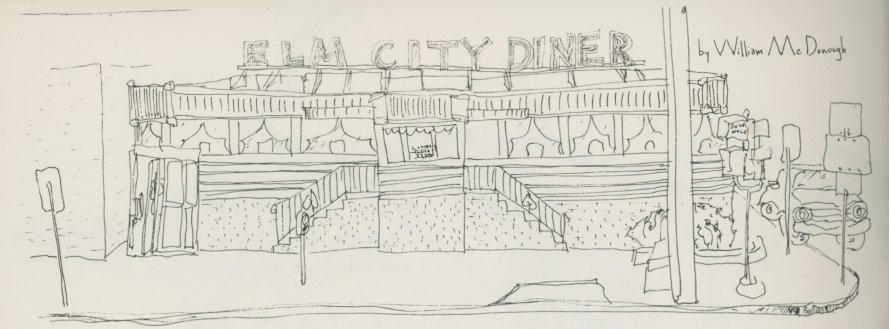
The Elm City Diner is a cigarette machine. It is also a juke box and a food vending machine (there are no short order cooks to watch; the food erupts from the kitchen). The menu cover shows elegant couples dining at a round table under a low chandelier and announces that Nick and Tony are your hosts twenty-four hours a day, every day. This is, of course, the way a machine should work. The Elm City Diner is a machine for eating in.
When I first came to this country I was told that your typical diner was a converted railroad car; a wonderfully rich image. The Elm City Diner has followed in the tracks of progressive diner design and, although not a railroad car, is still streamlined. It has become the vehicle for a splendid array of dry cereals, wet toast, plastic flowers, and fuzzy fluorescents. The streamlining also lets you feel removed from the eminently unsafe corner the diner overlooks. All those people who want to ask you for your money get shot around the diner’s rounded corner as you roll by contentedly eating your meal in relative peace unless, that is, the Westclox indicates that it is later than 11:00 pm when the outside comes inside.
It becomes apparent that the character of the Elm City Diner is a function of time as well as kitsch and design. In the morning it does not much matter where you sit as long as there is some light and a cup of coffee, but during the dark hours (outside) there is only one place to be if you are not part of the “action”: the corner booth, facing out. From this great vantage point you can truly experience the world around you. As you look out the curved window at the inhaling and exhaling bars you can also see a convex distortion of the entire interior of the diner with various characters moving both up and sideways at the same time. To top this off are the “extra booths” to your left which are permanently separated in their pristine glory by two aluminum stands and a velvet rope à la Lichtenstein. This area is a true wonderland; the booth seats are not marred by mystic tape, the sugar pourers are always full, and two mirrored walls reflect a tall orange plastic palm in a woven plastic basket and a failing philodendron in a clay pot. A two foot high version of Rodin’s “The Thinker” contemplates the whole scene from atop the cereal.
They say the lights never go out in Las Vegas and I know the lights never go out in the Elm City Diner; but I do not think the poor philodendron knows what to do.