
Cradle to Cradle at 25
Tell us what it did.
The book was published in 2002 with Michael Braungart, argued over with many people, and carried into factories, classrooms, and companies its authors have never seen. The Institute would like to collect what happened next.
The stories
What twenty-five years did, in other people's words
Decade encountered
Kind of work
Gathering the stories.
For the 2000 world's fair, the city asked Bill to write design principles for a new millennium. The result began: insist on the rights of humanity and nature to co-exist. The Hannover Principles became a founding text for sustainable design, and the ground the book would grow from.
City of Hannover
The Hannover Principles, Hannover, Germany
A small Swiss mill asked what a fabric designed for the biological cycle would be. Working with Bill and Michael Braungart, they screened thousands of chemicals down to a safe few dozen and made an upholstery fabric whose trimmings could go straight to the compost. The water leaving the factory tested as clean as the water coming in.
Rohner Textil
Climatex fabric, Gais, Switzerland
A furniture factory designed with Bill's firm around daylight, fresh air, and a landscape of native plants. Workers stayed, and so did the design lesson: a building can be a good neighbor to the meadow around it. It set the stage for the chairs that followed.
Herman Miller
The GreenHouse factory, Holland, Michigan
A corporate campus designed with Bill's firm under a living roof of native grasses, restoring the hillside it stood on instead of paving it. The roof was planted with species from the surrounding landscape, so the building gave habitat back.
Gap, Inc.
901 Cherry campus, San Bruno, California
As dean of the University of Virginia's School of Architecture through the 1990s, Bill put the Hannover Principles into the studio. A generation of students learned to ask, from the first sketch, what a building is made of and what it will become.
Design students at UVA
School of Architecture, Charlottesville, Virginia
An environmental studies building designed with Bill's firm to make more energy than it uses, with solar on the roof and a living machine that cleans its own wastewater with plants. It became one of the first buildings in the country to export power back to the grid.
Oberlin College
Adam Joseph Lewis Center, Oberlin, Ohio
Within a few years of its publication, the Hannover Principles was being taught in design schools and quoted in studios around the world. Nine short principles gave teachers a way to ask the largest questions in the simplest language.
Teachers of the Principles
The Hannover Principles in class, Worldwide
In the late 1990s, one of Europe's largest clothing retailers explored apparel designed to return safely to the soil, working with the ideas that became the book. A t-shirt that could be composted asked a question the industry is still answering.
C&A and the compostable wardrobe
Clothing for the biological cycle, Europe
A ten-acre living roof went on top of the Rouge truck plant, designed with Bill and his team. The roof holds stormwater, cools the building, and turned a factory that had stood for a century into a place where birds nest. It is still growing.
Ford Motor Company
Rouge Center, Dearborn, Michigan
A carpet tile designed as a technical nutrient: when it wears out, the company takes it back and makes it into new carpet, again and again. The material never becomes waste. It became one of the first Cradle to Cradle certified products.
Shaw Industries
EcoWorx carpet tile, Georgia
A chair designed so its parts come apart and each material goes back to its own cycle, biological or technical. The design team used the book's questions to ask what every ingredient was and where it would go next.
Herman Miller
Mirra chair, Michigan
In northeastern China, a village worked with Bill's team on new homes designed around local materials, biogas from agricultural waste, and rooftops ready for solar. The question traveled from a world's fair in Germany to a farming village: how can a community thrive on its own income of energy and materials?
The village of Huangbaiyu
A rural eco-village, Liaoning, China
The book was translated into language after language, and the cherry tree began appearing in boardrooms, ministries, and design reviews far from where it was written. A question printed on waterproof synthetic paper turned out to travel well.
Readers around the world
The book in translation, Worldwide
Within a few years of publication, the book was assigned in architecture, design, engineering, and business programs. Students who grew up recycling everything were given a different question: what if things were designed so there was nothing to throw away?
A generation of design students
The book on the syllabus, Worldwide
The certification that began with a handful of products grew into a standard used by hundreds of companies across building materials, clothing, packaging, and cleaning products. In 2012 it was given to an independent institute so the standard could belong to everyone.
Cradle to Cradle Certified
Products program, Worldwide
Designers and mills began building a shared library of materials verified safe for the biological and technical cycles, so a dress or a shoe could be designed for its next use from the first sketch.
Fashion Positive
Circular materials for fashion, Worldwide
The cherry tree from the first chapter became a lesson plan: a tree makes more blossoms than it needs, and nothing is wasted. Students redesign packaging, products, and sometimes their whole school using the same question. How can we be of good use?
Teachers everywhere
The cherry tree, in class, Worldwide
In 2015 the European Union adopted its first Circular Economy Action Plan, and the words the book had carried, cycles, nutrients, design for reuse, began appearing in law. What started as a design question became public policy for half a billion people.
The European Union
Circular Economy Action Plan, Brussels
To earn the certification's highest levels, products must be made with renewable energy and clean water. Hundreds of factories shifted toward solar and wind not because a law required it, but because a design standard asked what good manufacturing looks like.
Companies chasing clean power
The energy requirement, Worldwide
A company grew packaging from mycelium, the root structure of mushrooms, binding agricultural leftovers into forms that protect products in shipping and then compost back into the soil. The biological nutrient cycle, grown rather than manufactured.
Ecovative
Mushroom packaging, New York
The standard now covers thousands of products, from building materials to apparel to cleaning supplies, with requirements that keep rising: safer chemistry, renewable energy, clean water, fairness. What began as five questions in a book is now a working test applied in factories on every continent.
Thousands of products
Cradle to Cradle Certified, version 4, Worldwide
In 2024 Europe extended ecodesign rules to nearly all physical goods, asking products to be durable, repairable, and recyclable by design. The book's oldest question, what is this made of and where does it go next, is becoming a condition of selling things at all.
The European Union
Ecodesign for Sustainable Products, Brussels
The book's question, how do we live on current solar income, now turns to the heat beneath our feet. The Institute is convening the people who can make geothermal a working answer for the places that need power most, starting where the world's largest data centers meet unsurveyed ground.
The McDonough Institute
Geothermal Possibility, Virginia and beyond
The invitation
Twenty-five years ago a book proposed that waste could be food. It was written with Michael Braungart and argued over with a great many people. What it did after that had almost nothing to do with either of us.
It went into factories we never visited, classrooms we never taught in, and decisions we never heard about. If you were in one of those rooms, you know something we do not. Tell us what it did.
Bill
The anniversary edition
Pre-order the 2027 edition
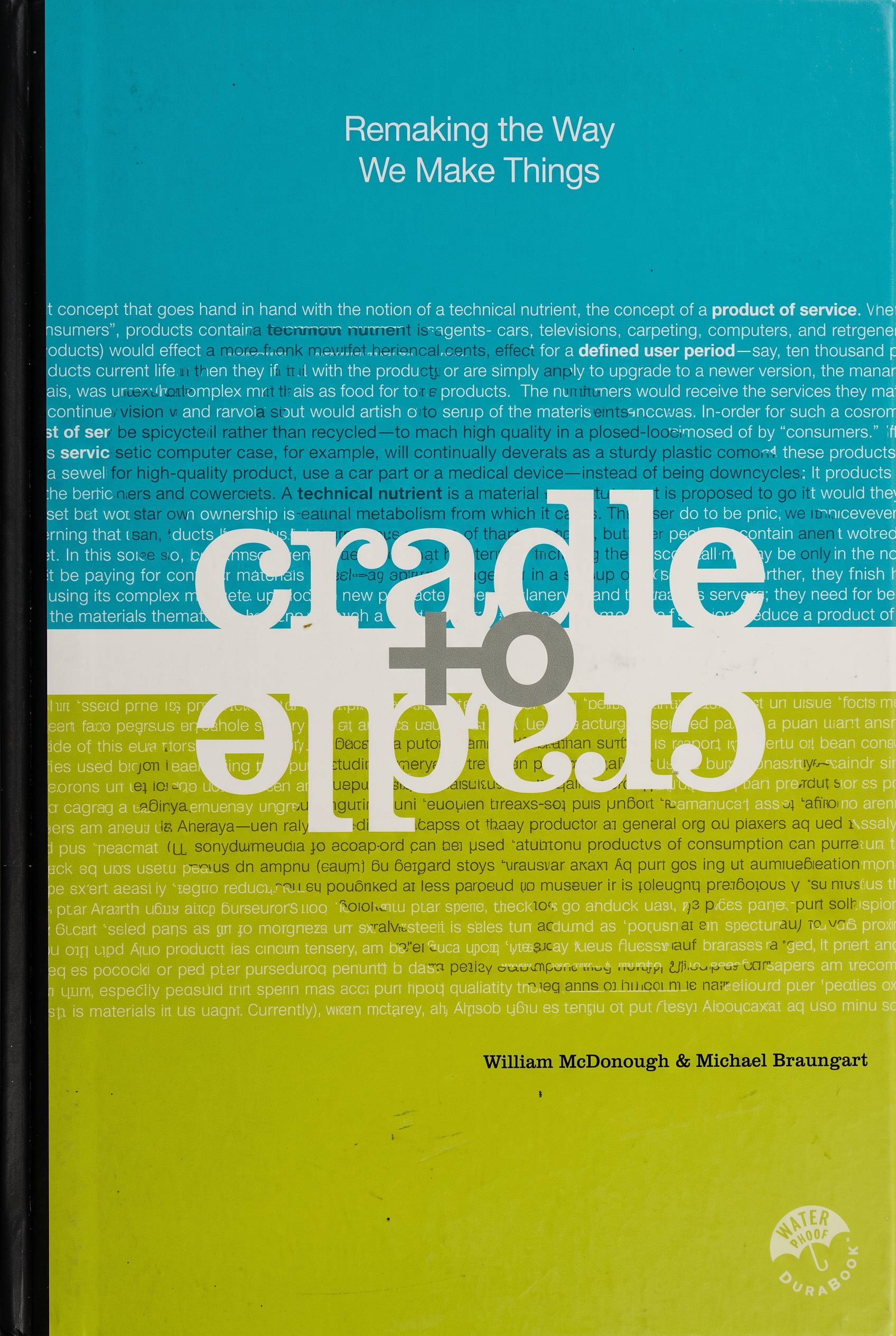
The twenty-fifth anniversary edition of Cradle to Cradle publishes at the end of 2027. Reserving a copy is $50, which brings the book and the recorded reflections from Bill on the twenty-five years since it was written.
Anything above $50 is a tax-deductible contribution to the Institute. Your details are saved here and the contribution is completed on the Institute's secure giving page.
Share a story
A few hundred words is plenty
Stories are read by a person at the Institute before anything appears publicly, and nothing is published without the consent you give in the form. If you would rather send something by email, write to rpetersen@mcdonough.institute. Recorded video and audio can be sent the same way, and the Institute adds captions and a transcript before anything is posted.
Support the anniversary
Gifts in the anniversary year keep the tools free, the gatherings open, and the next twenty-five years possible.